Sunday, January 5, 2014

A Tale of Two Tallises, or What a Difference Thirty-Two Years Make

It was January of 1982. I was president of my sisterhood in Anaheim, California, and preparing to lead my first Sisterhood Shabbat service. Our rabbi had thrown down the gauntlet. He fervently wished that Sisterhood and Mens Club Shabbat participations would be more than a few English readings. His vision was to be able to sit with his family (or maybe even stay home? Nah) and let the affiliate run the show - announce pages, lead the prayers, give the sermon, read Torah...all of it. I was only too willing to accept the challenge and I assembled women (OK so one of our participants wasn't really a Sisterhood member, but she was a woman and the daughter of our educator, so I considered her an honorary member) who would do the job. It was exciting and scary. Lots of our Shabbat regulars were resisting women's participation in services. We had to look good. I remember sitting in my rabbi's office and asking, "So, if I'm going to 'play rabbi,' should I wear a tallis?" I had no future commitment in mind, just the desire to do what was appropriate as the leader of the service.

My rabbi gave me wise advice. He said women didn't wear tallises in our congregation, and so if I did wear one, its shock value would overtake whatever positive effect I wanted to have by having an all-women Shabbat. He advised me that I should think about it carefully and be prepared to wear it after that Shabbat as well.

I went home and asked my husband if I could borrow his tallis for the event. He told me he'd be happy to lend it to me, but "I think you should make your own." Oh. I never thought of that..

That first women-led Sisterhood Shabbat, I went without a tallis, but I  committed myself to making one and wearing it, not just on Sisterhood Shabbat but every morning when I davened. I found all kinds of patterns and ideas and sought the advice of wise craftswomen in my congregation. I chose natural linen for the fabric, embroidered the atarah (band along the top side) and the corners using waste canvas and lavender thread, with beading on the atarah. It showed a Jerusalem skyline and carried the words of the psalm: if I forget you Jerusalem, may my tongue stick to the roof of my mouth. עם אשכחך ירושלים תדבק לשני לחכי. It brought me such pleasure to see the product appear. One corner had my Hebrew name, one had my favorite quote from Prophets, from Mikhah. The context is, "You have been told, Human, what God wants of you." Then my choice: only to act justly, love mercy, and walk humbly with God." כי אם עשות משפט ואהבת חסד והצנע לכת עם אלהיך The remaining two corners reminded me to choose life (Deut. 30:19) ובחרת בחיים and reminded others, while I creatively edited a piece of Torah, that God created woman ויברא אלהים את הנקיבה I loved that tallit, and I chose to wear it for the first time on the first day of Rosh Hashanah, 1982. New beginnings all around.

I was a wreck. It was a radical act I was contemplating, and I knew my relationship with my community would be forever changed, some for the good, some not. I didn't want to be kicked out of the room (I didn't really expect that, but you never know). I didn't want to be considered a "radical feminist." I just had found great meaning in wearing my tallit and wanted to be able to wear it at this important time in the Jewish year. 

The feelings of the community were echoed at home. My husband continued to be supportive. My oldest sat one day and watched me tie the tzitzit (ritual fringes) to the finished tallit and asked, "Um, Mom? Are you going to wear that all the time?" "Yup, every Shabbat and holiday." Pause. "Are you going to wear it when you give kids their Bibles on their bar mitzvahs?" "Yep." Oh I knew what was coming. "Are you going to wear it at mine?" "Yup." "What if a family doesn't want you to wear it for their bar mitzvah?" "I'll tell them someone else needs to be asked to give the Bible." Then I added, "Sweetie, your bar mitzvah isn't for over a year. By then no one will even notice I'm wearing it."

By the way, no one asked me not to wear my tallit when I presented Bibles on Shabbat morning.

That first Rosh Hashanah, I was glared at and scowled at, and admittedly my spiritual experience was less than spectacular. But it was important to  me when I actually wrapped myself in my tallit at the beginning of the service, and when I used the corner to touch  the Torah scrolls as they moved around the sanctuary. For the first time, I felt truly part of the worshiping community.

Slowly women began wearing tallit, one or two every year. I've been out of the community for over 20 years, so I can't report for sure, but women's participation has become normalized, so I suspect women and girls are now wearing tallit (and kipah) regularly. But my pleasure at donning my first tallit was mitigated by the discomfort I felt as I knew there were eyes glaring at me in disapproval.

Since then, I've had many tallitot. I was anything but a scholar when I made my first, and someone pointed out (rather unkindly) that I'd misspelled one of the quotes from Torah. Just today I noticed another misspelling on the atarah. The process of stitching makes it nearly impossible to tear out the offending letters and fix them, so I put the garment away in its needlepointed bag and sought a new one. I found it in Jerusalem, a glorious white garment shot through with silver thread. I wore it every Shabbat and holiday, but it began to show its wear. On another trip to Jerusalem, I commissioned a tallit from Yad LaKashish, Lifeline to the Old, a workshop that produces wonderful handcrafts. I loved that blue tallit, wore it every Shabbat and holiday, and kept the white one for Rosh Hashanah and Yom Kippur. (In case you're wondering, weekday mornings I wore my Seminary tallit - still do.)

Lately, that blue tallit from Jerusalem has begun to show its age and I resolved to begin looking for a  new one. But on my budget, that was on the back burner. Until a friend and colleague, Rabbi Chana Thompson Shor, who works in fabric art, posted some new designs to her Facebook page. She'd been posting lots of creations - matza covers, hallah covers, other tallit designs - and they were all beautiful, but I'd resisted making any commitment. This time, however, the sample she showed was glorious. I contacted her and we began negotiating. What to put on the atarah? On the ribbon that goes across the bag (in her design)? Can I have my name on one of the corners?

In true buyers-remorse style, as soon as I said, "Yes" and sent her my down payment, I began to wonder. Is the pattern too busy? Will I like it when it's done? Here's some new patterns she's posting. Maybe I should have waited.....? Maybe you know the drill.

Then the package arrived in the mail. I opened the package and saw the lavender velvet bag and gasped. How beautiful. How pleasing to my sensibilities. And then I opened the velvet bag and pulled out the tallit.

I cannot begin to express the joy I felt as the fabric spilled across my fingers. I am including pictures of both my first and this new one, but pictures cannot do the fabric justice. The main colors are a blue/lavender/purple spectrum, but there are splashes of gray in the pattern, and the gray has a sparkle to it. The garment truly sparkles. The atarah and corners are the same lavender velvet as the bag. The inscriptions are painted in gray. I wrapped myself in it and felt goose flesh rise on my arms.


I posted a picture of my new tallit on Facebook and received some wonderful responses, but none so wonderful as the reactions of people Shabbat morning when I brought "the real thing" into shul. There were gasps. Jaws dropped. One woman told me to hold on to it because it just might disappear. And I couldn't help but think back to that day nearly 32 years ago when I debuted my first tallit. There was no fear, no distraction. I walked proudly onto the bima (I was reading Torah that morning), not worried for a moment that anyone would look askance at my glorious garment. Times have clearly changed, in many ways.

That first Sisterhood Shabbat, I would never have guessed that wearing a tallit would be the first step in a journey that led me to the rabbinate (unheard of for Conservative women in 1982). The 11-year-old who was worried that I would wear my tallit to his bar mitzvah just showed the picture of my new tallit to his children, who, he tells me, were suitably impressed.

One more thing about my tallitot. The inscriptions have varied. My blue one declared, "For Zion's sake I will not be silent." This new one thanks God for ever guiding my steps (from the morning liturgy). But both have my Hebrew name in the corner. The front right corner, the one I use to touch a Torah scroll as it passes or when I'm called for an honor. It puts my parents' names front and center. And I love that while when a woman marries, her surname (usually) changes, she is forever the daughter of her parents. I think of characters like Erika Kane who had how many last names? Elizabeth Taylor. Lots of people, real or fictional. But whatever may come in my life, I will forever be the daughter of Eliezar Hayyim and Miriam, Louis and Mary. That brings me pleasure.It's a kind of identity that goes far beyond tallit. It's not just my role as participating Jew or leader in a Jewish community. It's my primal identity, the place where it all began. And it reminds me that my behavior is a reflection of my parents, even though they have been gone so long.

A glorious Shabbat. An accepting community. A beautiful tallit.  And my history on one of its corners. What a difference 32 years make!


Wednesday, December 19, 2012

Where's the Media When You Need Them?

Rabbi Yehudah, the compiler of the Mishna, is quoted as saying, "Much have I learned from my teachers, and from my colleagues more, and from my students the most of all." That is an observation that I believe would resonate with most teachers - no matter what we seek to teach, our students will inevitably have something to share with us that is of even greater value - an insight, an interpretation, an alternative viewpoint worthy of examining.

This past Monday, I met with  my seniors at their retirement community, where we shmooze on a weekly basis. Of course, this week the massacre in Newtown, Connecticut, was foremost in their minds, so we spent a good deal of time talking about violence in America and the issues of gun control and mental health resources. No one will be surprised to learn that while there was much agreement in some areas, there was heated debate in others.

One gentleman repeatedly offered a more historical overview than the rest of us - rather than talk about gun violence in the last decade or two, he spoke across the decades and around the world and said that there was nothing unique about the killing of 20 young children in Connecticut. "It's the media that was there right away, covering the event and constantly talking about it." I asked whether that wasn't really a good thing - were we supposed to ignore that it had happened?  Wasn't violence in this country really an issue? He agreed, but insisted that killings have always happened, and until a lot changes, things will continue to happen.

I've been thinking about his references to the media, that evil element of a free society. So much blame has been heaped on the media, for intruding into the lives of celebrities and of those confronting their 15 minutes because of a tragedy in their lives. And while all of that may be true, when it comes to violence, I think the media can play a role it has not understood for its importance.

I don't know about your local newspapers, but the Los Angeles Times regularly runs the obituaries of service men and women who die in combat. Photos accompany the obituaries, and the headlines regularly report the age of the fallen service member, usually way, way too young. While these obituaries are meant, I believe, to bring honor to our fallen, and that's appropriate, they also keep our country's forgotten wars in the public eye. Remember Afghanistan? The family of this fallen soldier or Marine will not forget it, the paper seems to be saying, and neither should we.

In the hours and days following Newtown, some of the outrage against the proliferation of weapons in this country (three hundred million guns? In a nation of three hundred million people? I can count on the fingers of one hand the number of people I know who own guns. So somebody must have an arsenal in their basement) pointed to the fact, similar to what my senior gentleman pointed out, that hundreds of children are killed by gunfire every year. Hundreds. Drive-by shootings. Some child finding a gun and thinking it a toy, shooting it, at themselves or a playmate. Some drunken family member coming home and in a rage starting to shoot. Hundreds and hundreds of children's lives are lost every single year, and no one is consistently outraged.

Certainly, local chapters of the Million Mom March are working to promote sensible gun regulations, but I don't think enough attention is being paid to the youngest victims of our gun culture. Why? I'm not sure. Are these children not important enough? Are they by dint of their neighborhood or the color of their skin not worth the attention? Are they disposable?

What would happen if every time - every single time - a child dies because of a gun, his or her picture and a short biography would appear in the local press? What if the public were not allowed to forget that a young life has been lost because of some twisted understanding of the Constitution? The newspapers tell us that the tide seems to be turning in this country, that it took the sacrifice of 20 young lives to wake up Congress and force them to turn from self-serving lobbyists to the obligation to protect our children. But the real debate has yet to be joined. We don't know today what the outcome will be, or even when the debate will begin. We still have, after all, that pesky fiscal cliff to deal with.

We must not allow the fervor to reform gun legislation and, again as my senior pointed out, to enforce those regulations already on the books - we must not allow that fervor to die. Because we've been stirred  before, and then the fervor goes away with the next crisis to face us.

We must not allow the sacrifice of the 20 children of Newtown (and the adults who tried so valiantly to protect them) to be wasted. And perhaps publishing a picture and a biography of every child whose life is taken by a gun in the local press will be a step in keeping our focus where it should be - on our future.

Thank you, Bernie, for making me think.

Sunday, December 16, 2012

Being a Jew in America

This separation of church and state thing is really pretty terrific, if it's allowed to function properly. For too long a time, we Jews were kept out of many areas of endeavor in the world, and even in this country until not too terribly long ago (read "A Gentleman's Agreement," written in the 1940s, if you need a reminder). Quotas in universities, doors closed to country clubs, housing covenants to keep out all those undesirables (us among them). And today we feel truly a part of the American fabric. Hanukkah lighting in the White House. Pretty cool. Passover seder in the spring. Also very cool. A warm recognition that we Jews have something significant to contribute to the American experience, not unlike those of all the other minorities that make up our country's patchwork quilt.

I kind of knew all that, but occasionally I need to remember that things truly are changing.

I think back to the mid-90s. A group of Conservative rabbis journeyed to Washington for a Rabbinic Lobby Day. We met as a group, then went to the offices of our various senators and representatives to speak about the issues that confronted our particular areas in the country. Somewhere or other I have a picture of me with Senator Joseph Lieberman, who was the senator from the state where I was serving a small community. I remember running up and down the staircases of the various office buildings and being so frustrated that my colleagues were so goal-oriented - they/we were under a time constraint and had to get to where we were going. But oh, that building was so beautiful! The wooden railings, the paintings on the walls, the seal of the U.S. Senate on the wall of the tram we took from one building to another. And hey, guys, all this is OURS! It was a real gosh-and-golly visit for me, but the highlight, without doubt, was our morning prayer service on Monday.

We met in hearing chamber - I'd like to say House hearing chamber but I'm not sure whether it was the House or the Senate - 30ish rabbis convened to discharge our obligation to God before we headed off to exercise our rights as Americans to speak to our representatives as Jews. We wrapped ourselves in tallit and tefilin, and one of our group, the grandson of Holocaust survivors, stepped forward to lead the service.

I remember looking around at the room. Old Glory on standards on either end of the seats where the members of Congress sat. A portrait of the president. And us. There were no police, no soldiers, no one glowering over our shoulders to make sure we weren't fomenting rebellion (you know those trouble-making Jews, after all). We were in that room because we had asked permission, as any group would, and had been given it. And on public land, we met as Jews to sing our prayers to God. Our leader opted not to have us go through typical repetition so that we could use our time more for singing prayers that are usually mumbled. It was a glorious morning, and I never felt more proud to be a Jew and an American than in that room.

Then there was today. Twenty minutes ago, to be exact. A colleague had been among those invited to a Hanukkah party given by Rep. Debbie Wasserman-Schultz of Florida. Ambassador Michael Oren of Israel was there. My classmate Rabbi Larry Bazer had officiated at the lighting of a Hanukkiyah at the White House, and now the festivities had moved on to Rep. Wasserman-Schultz's office. The West Point Jewish Choir (did you even know this thing existed???) was slated to sing. But Ambassador Oren brought with him three members of the Israel Defense Force Ensemble, a musical group, and without rehearsal the two groups joined in singing Hatikvah (Israel's national anthem) and Jerusalem of Gold. I don't know about anyone else, but for me it was a three-kleenex moment.* And while I wept, I reflected.

Jews at West  Point. A Jewish choir at West Point. Jews in Congress. A Hanukkiyah at the White House. Sixty years ago, had I predicted such a thing, my grandparents would have scoffed. And yet there we were. And those young people were just beautiful.

There's only one thing left: a Jew in the White House.

OK, so I'm being greedy. But do you remember when Joe Lieberman was tapped by Al Gore as his running mate in 2000? And Hadassah Lieberman raised eyebrows (and blood pressure) by observing that "now she felt like she truly belonged"? Many felt so uncomfortable by her remarks, but I got it. Born in this country to parents who'd grown up here but were born elsewhere, I still got it, and unless you've walked in the shoes of an immigrant Jew, you won't get it.

You know who does get it? Ask any African American in this post-Obama country how they felt in 2008. That's what it means to truly belong.

I will cherish these moments of melding of my American and my Jewish identities. I will celebrate the fact that as a Jew I am no longer invisible on the national stage, no longer excluded, no longer suspect (take that, U.S. Grant). I will thank God for all the good that this country offers to my community.

I just hope one of these days I will get to vote for someone with my communal memories with the same fervor and gratitude with which I voted for Barack Obama.

*If you're interested, the video is at http://www.youtube.com/watch?v=i15-8JCL_4s

Tuesday, December 4, 2012

Saying Good-Bye

It took a day, a day and Debbie Friedman, for me to begin grieving for Priscilla.

Those who knew her well, who saw her regularly, knew how ill she was, how the cancer was ravaging her. But living on the other side of the country, I had no idea, so the email informing me of her death was a terrible shock. Stunned, I moved through the day yesterday, struggling to process a new reality that was completely unacceptable. I wrote condolence notes to her four children, all former congregants. I went through the motions.

Then today, I visited my hospice patient, and as part of the session, I played Debbie Friedman's setting to Psalm 23. As I heard her sing, I thought about how we chant or read this psalm at some point during every funeral, and the words helped me feel as though I was there, at the service, undoubtedly at the synagogue she had joined when our little community closed eight years ago. And as I listened to Debbie sing and imagined myself in a pew in Metuchen, New Jersey, listening to another rabbi eulogize this remarkable woman, the tears began to flow, and I had to balance the grieving friend and the professional chaplain. It wasn't easy.

It occurred to me many years ago that eulogizing congregants is how rabbis grieve for them. Occasionally, a family asks another rabbi to officiate, and I find myself among the mourners, and there's something missing in my own grief. Today, the man who had become her rabbi eight years ago had the privilege of paying tribute to her, and I know he did a superb job. And I sit, trying to find the words to explain why knowing she is gone is so painful.

Priscilla and her late husband were my first contacts in Colonia, New Jersey. Her husband Terry z"l was the head of my search committee. I stayed with them while the parsonage was being repainted. I named many of their grandchildren. Their oldest is only a few years older than my oldest, so it was easy to come to think of their children as an extension of my own family.

So, yes, we were close.

Saying good-bye to her husband eleven years ago was one of the toughest funerals I ever conducted. And now Priscilla has gone to join him, and there is a hole in the world.

Priscilla was tough. She was the true matriarch of her family, never shy about telling her kids what she thought about choices they might have made. She had a wonderful sense of humor, and I can still see her laughing as she recounted stories from her children's childhoods. And she was at the center of the local Hadassah chapter. I can't think about Colonia Hadassah without thinking of Priscilla. She was a strong leader with vision and energy, and never dropped the ball when she took on a job.

She'd also been raised in a home where she learned respect and love for the Jewish tradition. I remember one evening when I made a shiva call on a family in our congregation. The house was filled with friends of the family. I found myself being pulled from one knot of people to another, but after a while I needed to leave. As I made my way into the living room, I passed Priscilla's chair and stopped to chat with her. "I'm sorry I haven't gotten over to talk to you before this!" I said. She looked at me and said, "No, Rabbi, you're my rabbi. I was the one who should have come over to talk to you." I was deeply moved at this expression of k'vod harav (honoring a rabbi). And there was no agenda to the remark. She meant what she said. She had firmly held principles and lived what she believed.

As committed as she was to synagogue life - she was president of my congregation and then of the congregation that absorbed our community when our building closed - and to the Jewish life of Middlesex County and of Israel, there was nothing more important than her family. Absolutely nothing. She would rearrange plans if she knew that a daughter or daughter-in-law was expecting a baby when a trip was being planned. She was Grammie to a dozen adored grandchildren, and the only blessing to be shlepped from this profound sadness is that her grandchildren aren't babies. They have grown up in the light of her love and they will have precious memories of her to pass on to their children.

It is a truism that the better you know a person, the harder it is to talk about them. I have buried so many parents of congregants and have eulogized them based on the information the family provides. Those tributes were fairly easy to write. But there were a few funerals in New Jersey that were very difficult to prepare for, because I had grown so close to the deceased. The feeling always lingers that I haven't said enough. I haven't explained enough about what there was about the deceased that has now left this world. The words have piled up and they are, in the end, only a pile of words. This blog feels the same. I have a picture of her in my mind, the sound of her laughter, her willingness to take me to the doctor when my car was in the shop and I was concerned about a spot that didn't look right - she heard the worry in my voice over the phone and was at my house in minutes. I am realizing that after so many years of being out of touch with her except for occasional emails and phone calls, she was still a presence in my life, and now she is gone. And I have written all these words in a vain attempt to paint a picture of a strong, Jewishly committed, loving woman, and who she was is still not here. And that is tragic, because she deserved better.

Good-bye, Priscilla. May your memory be a blessing to all who knew you.

Sunday, June 3, 2012

Waiting for the Ground to Stop Moving

Remember the 1950s? Things were so quiet, so calm, so easy. So safe. The icons of the day were Donna Reed and Robert Young and cute little Beaver Cleaver.

Everyone was white and straight. And women knew their place.

Then in 1954 the Supreme Court decided that segregation wasn't legal. And in 1955 Rosa Parks said no. And things were never to be the same.

Change followed change with what must have been, to those who had been comfortable in Eisenhower's America, frightening speed. The women's movement. Civil rights. Black Power. Roe v. Wade. Stonewall riots. Viet Nam. Assassination following assassination. Changing societal attitudes toward premarital and extramarital sex and a variety of drugs. Oh, and then there was the resignation of a president.

For most of us, especially those born in the 1960s, who remember nothing of the decades before, the changes in our society were just what there was. But for older generations, it was almost too difficult to deal with.


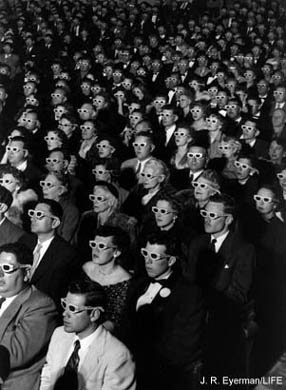
Don't these folks look fashionable?  3-D at its' best!In the decades that have passed since the tumultuous sixties, things seem to have quieted down. Images of interracial couples, that once sent people screaming from the room, are now commonplace. It's no longer necessarily a career breaker to announce that one is gay. The world we see in shots of audiences is very different from the world we saw in the iconic Life Magazine picture of an audience in 3-D glasses in a theater: in that picture, every single person was white. Every one. [see right margin] African Americans were either missing completely or in the balcony and safely out of sight. Today, a similar shot would show a marvelous rainbow of faces, a fairer representation of what America really is: white, black, brown, and yellow; single and coupled; able-bodied and disabled. And most of us who remember the Good Old Days cheer at the difference in how we present ourselves to the world.

Most of us. But for some, all those changes were just sources of discomfort that were swept under the rug. If we don't think about them, they'll go away. If our immediate world remains predictable, we're OK.

And then America had the temerity to elect an African American as president. Those who fought the onslaught of cultural change could no longer pretend that things were really still OK.

The upheaval of the 25 years between 1954 and 1979, like the Viet Nam War that fell within it, is still being felt. Aftershocks of those temblors continue to resonate in our culture. And like any violent movement of the earth, we are left off-balance. And being off-balance makes us insecure, makes us want to find a place, whether physical or in memory, where we were safe.

So we want to go back to the way it was.

I can't figure out a better explanation for the behavior of legislators both in Washington and in state capitals around the country, legislators who were swept into office by people who wanted a solid piece of ground to stand on. Ground that did not include the safety of abortions in clean clinics. Ground that did not include contraception and the accessibility of women's health screening to all women, even the most poor. Women in particular seem to have become the target of the insecurity of the earthquake generation, because after all if women would only remember their place, things would be so much more bearable. The days of returning home to a wife in pearls and a waiting martini (or Coke) seem so appealing (never mind the cost to the women who did what their husbands wanted to the exclusion of their own needs).

I even wonder whether the illegal immigration problem would be so severe if the flood was coming from the north. Because the uptick in suspicion of people of color, the continuing racial profiling despite laws passed against it, are telling me that it's not just women who are being targeted. We are aware (or we should be) of the disproportion of black inmates in our prisons, not because more blacks commit crime, but because most blacks have to rely on overburdened public prosecutors who advise them to accept a plea bargain rather than go to court. The number of incarcerated blacks who are being released after decades of imprisonment thanks to improved forensic science only proves the point. All blacks, after all, look alike, so if one is accused and has not adequate representation, one ends up behind bars. And no one cares.

If Barack Obama's father had been a Swedish student here on a study visa, fathered a child, then went back to Stockholm, would Donald Trump and Orly Taitz still be stamping their feet and demanding a "real" birth certificate? But a man of Mr. Obama's skin color must be proved to be ineligible to hold his office. (We all know that his skin color alone should disqualify him from sitting in the Oval Office, but apparently the Founding Fathers lacked the foresight to insert that stipulation.)

Every time a member of the earthquake generation watches the 6 o'clock news, he or she is reminded that things aren't the way they should be. And he or she, out of a profound sense of insecurity, demands that everything that has changed in the past 50 years return to the way it was.

Look around. Nothing is the way it was after an earthquake. Just ask the people in Haiti. Or Japan. Or northern Italy. Or Northridge, California. The earth moves, landscapes we loved disappear, and new ones replace them, and in a decade or two we have come to be settled in our new landscape. Unless we are so mired in the past that we can only mourn what was and curse the fates that caused what we had to crumble.

It's time to wake up. The America that has emerged from the upheaval of the 50s and 60s and 70s is a richer, healthier, more vibrant America. It welcomes the contribution of effort of all its citizens. And to demand that we return to Father Knows Best is to do precisely what democracy is NOT about: comforting the minority to the exclusion of the majority.
I am indebted to Robert D. Putnam for the image of repeated upheavals in our society, described in his new book, American Grace.

Thursday, May 3, 2012

Washing Away the Week

We are told that there are so many ways to reduce or eliminate stress. Exercise. Meditate. Yoga. All of them are effective, but I found a new one last week that takes all of a minute (yes, a minute, if you are among the ADD population). It combines an insight found in an online publication with the wisdom of Rabbi Abraham Joshua Heschel. I considered doing it, figured out how to make it real, and oh my - it really worked.

The article, which appeared in the online edition of Spirituality and Health, reflected on the healing aspects of water. While immersion into a ritual bath has long been part of Jewish religious practice, not every Jew takes advantage of the practice, and frankly, it takes the time to find a local mikveh, get there, wait your turn...you get the idea. And I'm unaware (although I'm counting on my followers to correct me if I'm wrong) of any water practice among other faith traditions. The author of the article suggested that we take the opportunity to use the healing powers of water at times that would seem to be fairly mundane: when we take our morning shower, she suggests, allow the water to roll off us and speak or think words of purification for the day to come. Or if we shower at night, let it be a time to wash away the stress and spiritual impurities of the day. Remarkable, I thought. Really wonderful.

Then, a couple of days later, I took my turn in a rotation of rabbis who have been teaching Rabbi Heschel's book The Sabbath at my local synagogue. One of the points Rabbi Heschel makes in the chapter we were studying is the need to prepare spiritually for Shabbat. Even in traditional households, where women are focused on the home and children, the end of Friday preparations can be hectic - make sure the food is cooked, the children are bathed and dressed, the table is set, the candles are ready to be lit...But so much the more so in our contemporary society when both parents are often hurrying home from work, and certainly in the winter months when the sun sets early, we race home, checking all our prep items, and rush to our candles to light them (and the men often rushing to make the early Friday night service).

Spiritual life takes preparation. It takes as much work as preparing for an interview or an exam. Rushing toward the spiritual takes energy away from the ability to experience the connection we seek. We are too tired to appreciate what we have.

As the group discussed the need to stop and prepare, I shared with them to idea of using water. Perhaps, I suggested, we could make the point of washing our hands just before candle lighting or reciting kiddush (sanctification of Shabbat made over a cup of wine) or heading off to synagogue. And then I resolved to see if I could craft such a ritual in real life.

The next week was a killer. One stressful day after another. Difficult issues to confront. Decisions to be made. Disappointments to deal with. On Friday, I made sure my kitchen was prepared, and I set up my candles. Then I remembered the ritual I wanted to invent. I found the special cup I use to wash my hands before hamotzi (the benediction over bread), went to the sink and did the following:
1. Filled the cup.
2. Poured water over my hands but didn't recite a benediction since I wasn't ready to eat yet.
3. Shook out my hands.

It was here that the magic happened. I shook my hands only three or four times, but each time was a single strong, decisive shake. And with each shake, I let go of something.
"letting go of the stress"
"letting go of the worry"
"letting go of the anger"

and then I held up my hands as a doctor would when a nurse is going to glove her before surgery and I said
"getting ready to receive the holy" And the holding up of my hands and the words I spoke made me aware of the presence of God as I normally am not aware except for the moments after lighting my candles or putting on my tallit.
 
Then I went to dry my hands. And the most remarkable thing happened. I realized I'd shaken loose all the stress I'd brought with me to Friday night. I was the calmest I'd been in days. When my cousin came home I wished her a Shabbat shalom and smiled and she asked what was going on that made me so happy, and I told her about the ritual.

The calm I felt on Friday night has carried me through the week. I've ceased worrying about things I can't do anything about. I've slept better. The effect of a few shakes of my hands has been profound.

Tomorrow night I'll do it again. And prepare myself once again for a Shabbat of peace.

Monday, June 6, 2011

The Other F Word

George Santayana observed famously that those who do not remember history are doomed to repeat it. It is that observation that makes reading history and remaining up to date on current events so important. Sometimes, keeping up to date on current events can be depressing at least, frightened at worst, but the alternative is to invite catastrophe.

It boils down to connecting the dots. Looking not at individual news stories but at the larger picture, and assessing what that larger picture portends for the future of our country.

Item: More anti-abortion legislation has been passed in the months since the 2010 election than in the decades since Roe v. Wade. Legislatures, both state and federal, faced with mounting deficits and unemployment numbers, have chosen instead to put their combined energies into restricting the right, established by the U.S. Supreme Court, of a woman to chose what happens to her body.

Sub-item: the laws, typically (with some hair-curling exceptions) do not decree abortion to be illegal (can a state make illegal something the federal courts have determined to be legal? That remains for some brave woman to bring suit if these laws are passed – and the prospects for passage are unfortunately very good), only make it damned hard for a woman to find an abortion provider. South Dakota, as an example, has one abortion provider for the entire state, and if you look at your map, it’s not a small state. If you find yourself in the position of needing an abortion, you have to come up with both transportation and lodging fees to get to the provider. Right now, there’s a 24 hour waiting period between checking in with the provider and actually having the procedure. But wait: there’s more. If the legislature has its way, the waiting period will be increased to 72 hours – increasing the number of nights a woman must pay for lodging. And yet more: the provider has only limited office hours, so 72 hours usually translates to a full week between the first visit and the procedure. With many women unable to take a full week to travel across the state and/or be able to come up with the additional fees for travel and lodging, these draconian rules put safe, legal abortion out of the reach of many women. Oh, and did I forget to mention the “counseling” the women have to endure? As if having an abortion is a decision come to on a whim. The arrogance of these legislatures, imposing themselves between a woman and her doctor (and her clergy if she chooses to include him/her) is breath-taking. And yet some states are working to criminalize abortion to the point of incarcerating providers (and some have even considered jailing women who have sought abortions). The clock seems to be turning back to 1900. While people are using up their unemployment benefits and losing their homes, legislatures are targeting women with unwanted pregnancies.

Item: A number of state legislatures have stripped unions of their bargaining power. Some of my Republican friends have observed that while unions once had a place, now they’ve outlived their usefulness. Really? Is salary and health care the only reason to bring management to the bargaining table? What about safety issues? What about length of hours and breaks and lunch? What about the quality of the work environment? If you think that unions are no longer necessary, get rid of them and see how fast municipalities are ready to spring for new safety equipment for fire fighters and police officers without the threat of a work stoppage. No one with budget responsibilities ever spent a cent unless pushed to do so, and if striking gets the money spent to ensure the safety of the work force, then that’s what it takes. And how to mobilize without a union? (Although the rebels across North Africa and the Middle East seem to have succeeded with Twitter and Facebook, but come on. This is America. Do we really need to resort to technology to bring management to the bargaining table for simple requests? Wait – I guess we do now, in too many states across the Midwest.)

Item: Michigan has gone one step further and empowered the state to dissolve the local, legally elected government of any municipality it chooses and to put a state-appointed – what, czar? uberfuerher? director? – over the affairs of the municipality. What kind of country has states dissolving local government? Apparently, ours.

Item: San Francisco, long a favorite city of mine, now has on an upcoming ballot an initiative to criminalize circumcision. And the most troubling part of the text is that there is no exemption for religious observance. We Jews of course circumcise our boys on the eighth day of life, and Muslims circumcise their boys before puberty. These are religious obligations. Even in the darkest days of Prohibition, accommodations were made for wine used for ritual purposes. This initiative goes way beyond the boundaries of liberal how-can-you-mutilate-your-babies mentality. The most frightening part? Check out this link. If you think, as I did a week ago, that this is just foolishness from people who want to leave circumcision to their boys when they turn 18, read about Foreskin Man (I kid you not) and look carefully at the graphics. The art work in this “publication” mirrors some of the worst of Nazi propaganda in the dark days before the implementation of the Final Solution. www.foreskinman.com

So how do we connect the dots?

Look around. What’s going on in our country? We are still in the throes of the worst financial crisis in 80 years. Unemployment as of yesterday went over 9% nationwide, far higher in many states (including here in California). People are frightened, and when people are frightened, they look for scapegoats and easy answers.

What’s “the other F word”? Fascism.

Fascism, as in the hatred of the Other, the mistrust of the Other, and the circling of the wagons while attempting to build a society that’s ordered and predictable. Women know their place. Everyone looks like us (read: white and Christian). Law-breakers are dealt with mercilessly. People who follow laws informed by non-Christian faith traditions are suspect and must be controlled. Unions are the expression of the people and therefore must be silenced. Only a strong central government can be trusted to take care of its people (even, as in the case of personalities like Michelle Bachman and Sarah Palin, they don’t even have their history straight). Rights get to be restricted. And if you say something wrong long enough, people will begin to believe it. Like “death panels.” And “our black president was born in Kenya.”

Change is frightening. Having a national leader that doesn’t look like “us” is frightening. Instability is very frightening. And the way to deal with change and instability is to impose more and more tightening laws that invade people’s personal lives, imposing the ethics of one faith tradition onto those who do not share that faith tradition.

We hear so much about the right to bear arms. What about the part that says that the government shall make no law regarding the establishment of a religion? Or do we just pick and choose which part of the Constitution we hold sacred and which part is disposable?

Do we rewrite history to make it fit our contemporary notions of safety and order? Or do we study history as it is, in order truly to preserve the safety and order of the society we have built over more than two centuries?

We need to connect the dots. We need to stay awake. We need to speak out, to support the good people of Wisconsin who continue to sit in at the state capital, to support Planned Parenthood, 97% of whose budget goes to providing contraception advice and free mammograms and Pap smears to women who can’t afford to get them elsewhere. We need to keep in mind that no – NO – federal funding goes to providing abortions through Planned Parenthood, so those who wish to cut their funding (and some states have already succeeded) are not reducing the number of abortions in their state; rather, they are limiting women’s access to preventive health care.

Attacks on unions. Attacks on women’s health. Attacks on religious freedom.

Are we going to remember history? Or, God forbid, will we allow it to be repeated?

Monday, May 16, 2011

Jewish Parenting Through the Lens of the Liturgy - 3

Traditionally, morning prayers open with a list of 14 benedictions, originally said as people began their day - there was a prayer for unwrapping oneself from one's covers, for putting on one's shoes, for tying the belt around one's coat. Eventually, the list found its way into the prayerbook and was recited together, whether at home or in the synagogue, after all those preparations had already been completed. As I have read these benedictions, I have been regularly impressed with lessons they can teach us as parents, and in this blog I will be reflecting on each of the benedictions, one a day, for the next few weeks (holidays permitting).

*******

The Third Benediction – Religious Identity

ברוך אתה ה' אלהינו מלך העולם שעשני ישראל

Praised are You, Adonai, our God and Sovereign of the Universe, who made me a Jew.

There is much to be written about this brakha. I have met with so many people who were in the process of conversion, either about to begin their study or about to be immersed in the mikveh, and over and over again I hear the same thing: I’ve always been a Jew. This is just making it official.

This conviction suggests a truth to be found in our brakha: that religious identity is part of our make-up as much as height, eye color, and sexual orientation. Of course, we might then question those who profess no religious belief, or those who are conflicted about the existence of God and how they might worship that God. Are they denying their essential spiritual identity?

I can’t address those important questions. What I do know is that the Jewish tradition speaks of the pintele yid, the Jewish spark that is found in the Jewish soul. No matter how assimilated the family, how unidentified the family, somehow that tiny spark finds a gentle breeze to blow on it and fan it into a flame. How it is that some have that spark and others do not is a quandary of a mystic nature, and I am far too unqualified to address it here.

What our brakha tells us, however, is not that we acknowledge our Jewishness but that we are grateful for our Jewishness. We remain Jewish not to deny Hitler a posthumous victory but because being Jewish is a wonderful, exciting thing, for most of us a delightful accident of birth, and our obligation is not to run from it but to find reasons to say this brakha with joy each morning.

But what does all this have to do with parenting?

When our children are born, we watch with delight as they blossom, from tiny infant to toddler who learns “No” very early and enjoys pushing the envelope, to adolescent who raises pushing the envelope to an art form. Along the way we watch talents and interests emerge. Who will this precious gift of God be? What will he or she be? How will our child contribute to the community? What sort of partner will we hope he or she finds – what characteristics do we want to see encouraged, which ones balanced with someone complementary?

We worry about the friends they choose, the schools they attend, the extracurricular activities they participate in. Have they accumulated enough activities to impress the admissions committees of the colleges they’ve chosen?

We set curfews for them, give them rules, let them know what’s expected of them as members of our family.

And yet for so many parents, encouraging religious education is merely a means to an end: the bar or bat mitzvah celebration. And even among those parents who opt for a celebration of their child’s coming of age within Jewish tradition, the spectrum varies from day school to supplementary school to a tutor and a private service, with the party being the most important element of the day.

We want our children to be functioning members of society, but too many of us feed our children’s intellect while starving their souls.

I must tell you that when people learn I’m a rabbi, whether they’re Jewish or not, they feel comfortable sharing incidents or whole themes from their childhood dealing with their religious upbringing – or lack of it. I remember one young man who shared a dinner with me and members of my first congregation many years ago. He reflected that both his parents had been raised as Protestants, but different denominations. Each of them had had parents of differing denominations as well, so that by the time he arrived on the scene, there were maybe six different ways of worshipping Jesus in his family. His parents’ strategy was not to offer him any of them. It was clearly too complicated for them, too much of a mine field to traverse, so they gave him a terrific secular education but never addressed his soul. He said to me, “I want to think about God, but I don’t know how think about thinking about God.” I suspect (although I can’t be sure) that if he’d told his parents that, they would have been puzzled at the least.

I also remember an interfaith couple that, like many, decided to give their daughter both Catholicism and Judaism. She was converted by my predecessor and then the next day she was baptized. Her education consisted of Hebrew school on Sunday and catechism on Saturday. I finally told her father that she needs to be given an address for her soul. I would rather, I told him, see her go to church regularly with her mother and know she’s being given a consistent religious education than be taught two very different paths and be expected (a) to sort them out by herself and then (b) choose, essentially between Mom and Dad.

I was asked once as part of an interview for the post of senior rabbi at a Midwestern congregation, “Rabbi, how do you teach God to children?” I told them frankly that we don’t teach God to children. Children are born far closer to God than we will ever be. Their souls are new and freshly given by the Holy One. We should be asking them what they know about God.

What happens from birth to adulthood is the channeling of that belief by how the adults in their lives talk about God (or not). Furthermore, belief in God is only part of the conversation; the rest of it has to do with how we worship the God in whom we believe, how that belief translates into behavior and the search for community. Simple faith is a lonely thing unless you have others with whom to worship, and with whom to sort out what God’s will means to you. For us Jews, that means family and community with whom to study Torah and build communal institutions so that we can follow the path our tradition has defined for us. Having a child, then, means not only committing to a lifelong (yes, it really is lifelong) endeavor of educating and training and civilizing (I’m thinking of those toddlers and adolescents again) and constantly reassuring with unconditional love. It means before they’re born sorting out what God means to you, what your faith community means to you, and finding a place in that community where you are comfortable and can feel joy. Then, when your children are born, they can watch you participate in your community’s events and celebrations because they’re meaningful to you. Children know very early what’s important to their family, and they perceive very quickly that religious life is irrelevant if it’s only “for the children.” I was thinking the other day of my first Hanukkah as a married woman. We’d moved out of state for my husband’s education, and I spoke to my parents, excited about having lit our new hanukkiyah for the first time. “Oh, we didn't light ours,” my mother said, to my astonishment. “You’re not here so it’s not so important.” Of course, in hindsight, I realize that that first year their only child was out of the house was a big adjustment for them, but at the time I couldn’t believe that all those years, my parents had celebrated Hanukkah only for me.

I’m slow, I guess. Other kids pick up on things much more quickly. One of my fifth grade students once observed that sitting in a sukkah for a week was a negative mitzvah because “nobody does it.” In his home, at least, there was no sukkah. The synagogue’s sukkah wasn’t “real” because after all it was the synagogue’s sukkah. I tried to explain that thousands of Jewish families around the world (including mine) used their sukkot every year, but he wasn’t convinced.

How can we say our brakha every morning with joy, affirming our awe at being part of this remarkable people? We can study Judaism just as we studied whatever texts we needed to study to pursue our profession, recognizing the truth of the brakha “thank You for the obligation of making Torah study our occupation.” We can live Jewishly by bringing Jewish practice into our homes and our lives. We can study with others to learn what makes Judaism remarkable to them. And in this way we become role models for our children.

When we do recite that brakha, let’s use it to remind us to do all we can to encourage our children to come to value being Jewish as much as we have learned to be.

Tuesday, May 3, 2011

We Have More Problems Than We Even Knew We Had

I've been doing a lot of thinking lately about the birther phenomenon. Many commentators, including Rachel Maddow, have labeled it for what it is: racism. Somehow we have to delegitimate this president without actually saying out loud "A black man can't do that." So we cast aspersions on the details of his birth. Shameful enough.

But I think there's another phobia going on. Let's think back to the 43 presidents who came before Mr. Obama. Yes, all men. All white. Yes. But there's something else about them. What were their names? Washington, Lincoln, Grant, Johnson, Madison, Jefferson (I know, they're way out of order), Jackson, Taft, Wilson, Truman, Bush (x2), Clinton. Do we see any commonality here?

Every one of these names can be traced back to the British Isles. Only three presidents (by my reckoning) had names that were non-Anglo: two Roosevelts and Eisenhower. And two of them were war heroes (TR in the Spanish-American War, Ike in World War II) and the third had extensive experience in state politics, had a connection to an earlier Roosevelt, and was endowed with great charisma of his own. By the time FDR ran for the White House, "Roosevelt" had become less a Dutch name than a good American name.

And you can count those presidents with non-Anglo names without going to a second hand.

As I was ruminating on the birther phenomenon the other day, I wondered whether the same grief would befall a president whose father had been here in the States on a student visa from, say, Spain or France. The candidate would look like all previous candidates (read: white) but the name would be foreign and the story would have been the same. Would the birthers in this country have been more accepting?

At first I sputtered "Of course!" But then I began wondering. The story goes that when Pierre Mendes-France ran for the office of president of France in the 1950s, this Jewish candidate faced the ire of his conservative opposition, who announced that their candidate was "a *real* Frenchman," this despite the fact that Mendes-France's family had been in France for five centuries. Apparently, according to some, you couldn't be in France long enough to be "real" if you were Jewish.

So then I started thinking about a President Ramirez. Or a President Chen. Or (God help us) a President Al-Fasi. The closest we came was Vice President-almost Joe Lieberman. And if Al Gore had won the election in 2000 and Lieberman had decided to run on his on in 2008, he'd have had a good uphill climb that had nothing to do with politics.

We have more problems in this country than simple racism. We are a country of xenophobes. We are distrustful of anyone whose name places him or her outside the British world. And so it seems that our president has two strikes against him. In his own words, he's a "skinny black guy with a funny name." And that funny name causes a certain population in this country as much difficulty as the color of his skin.

When you think about it, this mistrust of people with funny names is ironic in a country that prides itself on being a melting pot. We are Latino and German, Polish and Russian, Jewish and Irish and Chinese and Vietnamese and Indian and Pakistani. Many of us came here with names unpronounceable and unspellable by the immigration authorities at Ellis Island. Some of us had our names changed, others just tweaked the spelling so our neighbors could greet us each morning. There is no such thing as a native American (except for those known as native Americans) in the same way there are native Frenchmen (or Frenchwomen), native Brits, native Russians. We are not ethnically homogeneous.

And yet we are suspicious of people whose names are clearly different. (And of course that "Hussein" in the middle of his name didn't earn him points with many Americans.) There would have been those who would have whined about the president's birthplace if his name had been Washington or Jackson or Powell or any other name rooted in the British Isles. But how much easier it is to get attention when the names spoken during the oath of office on January 20, 2009, were so foreign sounding.

We have a long way to go in this country. Enough people displayed common sense in 2008 to get beyond the name and the color of skin to make a decision based on Dr. King's "content of his character." But the fact that the birther issue will not go away tells us that these people with too much time on their hands have touched more than one exposed nerve. It's bigger than color. It's that Mr. Obama is different - Different - in so many ways that he can't possibly be really American. And in that opinion they demonstrate how little appreciation they have for this country, for what makes it great. It is precisely America's diversity that is its strength, and what makes our president remarkable (political choices aside) is how well he represents that diversity.

And as long as people can complain that Mr. Obama is illegitimate, and polls can reveal that a disturbing percentage of the voting public agrees, we will have more problems than racism to overcome.

Saturday, April 23, 2011

Jewish Parenting Through the Liturgy - 1

Traditionally, morning prayers open with a list of 14 benedictions, originally said as people began their day - there was a prayer for unwrapping oneself from one's covers, for putting on one's shoes, for tying the belt around one's coat. Eventually, the list found its way into the prayerbook and was recited together, whether at home or in the synagogue, after all those preparations had already been completed. As I have read these benedictions, I have been regularly impressed with lessons they can teach us as parents, and in this blog I will be reflecting on each of the benedictions, one a day, for the next few weeks (holidays permitting).
*******
The First Benediction - Making Distinctions
ברוך אתה ה' אלהינו מלך העולם אשר נתן לשכוי בינה להבחין בין יום ובין לילה
Praised are You, Adonai, our God and Sovereign of the Universe, who gave the rooster the ability to distinguish between day and night.

What an odd benediction! Why on earth would we be worrying about roosters? The language, of course, is symbolic - back before alarm clocks and the plethora of technology that wakes us up in the morning, there was the local rooster, crowing often before dawn, to get our day going. We depended on that guy, to be sure we were awake in time to say the morning Sh'ma, so that all our obligations could be fulfilled at the proper time. We were, therefore, thanking God for putting mechanisms in place in the natural world to help us fulfill our obligations to God.

So what does that have to do with parenting? I like to think of the benediction as making a statement about the ability to tell the difference between black and white. If, after all, a mere rooster can tell when the sun is up far enough to announce the new day, why can't we make distinctions?

I'm thinking in particular of the choices parents make when disciplining their children. When we are in the midst of a behavioral crisis, the last thing we are able to do is step out of our confrontation with our son or daughter and consider just what we are doing. To my way of thinking, knowing the distinction between day and night, in parenting terms, is knowing what to "go to the mat for." How can we tell the difference? How can we know when to smile and let it go, and when to put our foot down? How do we deal with tantrums? When do we just let it go, and when do we apply the time-out? There are no easy answers, but the asking of the questions is what's important. A rooster may know the difference between day and night, but after all isn't the presence or absence of light fairly obvious? Making distinctions in how we respond to our children's behavior is far more difficult.

I don't have any wisdom to impart. What I do have is the experience of raising three rambunctious sons and watching (at this point) two of them raise their own children. I also have the experience of watching my friends' children and grandchildren, and of having to bite my tongue on a regular basis, sometimes, watching certain behavior, thinking, "Why are you allowing that behavior?" and other times, watching other behavior, thinking, "Is this really so terrible?" There are parents who are afraid to say no, afraid to set limits, afraid their children will hate them. And then there are parents who feel the need to control every one of their children's choices. Neither of these kinds of parents has figured out the need for distinctions. Neither of these kinds of parents has fully embraced the idea that parenting is very hard work, and that the work isn't only about laundry and finding the right schools and keeping the kids in clothes and shoes. The real hard work comes with understanding what's expected of us as disciplinarians. We know we need to be consistent in our approach, but consistent how? Always saying no? Always saying yes? And is "consistent" the same as "always"?

There is, of course, another difference between parenting and listening to that rooster. God put in place in the natural world a mechanism to get us going in the morning so that our obligations may be fulfilled. I'm not aware of any mechanism in the natural world for knowing instinctively when to allow and when to say no. Making the decisions about how to raise our children to be happy, healthy, well-adjusted adults is the toughest job we will ever take upon ourselves. But maybe if we begin our day with the morning benedictions and we recite that first benediction with mindfulness, with kavanah, we can focus our thoughts each day on the need to make distinctions in the way we confront each foot stomp, each NO!, each tantrum, each attack of one sibling on another, and most important, each challenge to our authority. And maybe just the awareness that we have choices at each step of the way, and that the choice we make in the morning may not work in the afternoon, can be the first step in raising our children right.

Jewish Parenting Through the Lens of the Liturgy - 2

Traditionally, morning prayers open with a list of 14 benedictions, originally said as people began their day - there was a prayer for unwrapping oneself from one's covers, for putting on one's shoes, for tying the belt around one's coat. Eventually, the list found its way into the prayerbook and was recited together, whether at home or in the synagogue, after all those preparations had already been completed. As I have read these benedictions, I have been regularly impressed with lessons they can teach us as parents, and in this blog I will be reflecting on each of the benedictions, one a day, for the next few weeks (holidays permitting).
*******
The Second Benediction - The Yin and the Yang
ברוך אתה ה' אלהינו מלך העולם שעשני בצלמו
Praised are You, Adonai, our God and Sovereign of the Universe, who made me in Your image.

I have for a long time understood this benediction from a parenting point of view as turning our focus on each of our children as they are, not as we would wish them to be. Whether we have one or ten, some kids are just as we would have wished, others aren't. Some want to follow in our footsteps, others have no interest in our life's work. Some remind us of beloved relatives, others of relatives we would rather forget. We project so much onto our children, from the moment of birth (whom does the infant remind us of?), that sometimes we forget that we are dealing not with a reflection of someone else's character or dreams or goals but with an unfolding gift from God, created in the divine image, with dreams and goals of their own. If we are made in God's image, so too are our children - and our job is not to create them into our image but to encourage the God-given talents they possess so that they may blossom into their own rendition of the divine image.

That's been my understanding for many years. Today I have another understanding to add.

A careful reading of the Hebrew in Torah will remind us that there are two basic names for God, found in our sacred text and in our liturgy: Adonai and Elohim (rendered eloheynu - our God - in prayer). The rabbis of our tradition puzzled over these two names, deciding that like any name, these terms have come to teach us something about the God they describe. The entire first chapter of Torah refers to God as Elohim. It isn't until after the beginning of chapter two, when the first week of creation is finished and we turn to the more detailed story of the creation of Adam and Eve, that the name Adonai appears. Why this distinction, the rabbis ask. And of course they have an explanation.

God has two overriding qualities: the quality of justice and the quality of mercy. In the first chapter of Torah, the world is created in a rather removed way: God say "Let there be..." and there was. Creation happens with words, not by interaction with the creation. Everything is orderly. Each day has a purpose. And God is Elohim. So this then is the expression of God as Judge, and meter-out of order and logic.

Comes chapter two, and God - Adonai this time - gathers earth from the four corners of the world and shapes a person. Shapes a person. Hands-on. Breathes the breath of life into the person's nostrils. Breathes into the person's nostrils. This is an involved God, and a God that is dealing in an on-going way with people, those creatures with the free will chip. And so the name of God is Adonai, an expression of the quality of mercy, since without mercy, those people would not long survive. Remember that the first limit God imposes is that Adam and Eve not eat of the fruit of the tree of knowledge of good and evil. And the first thing they do is eat the fruit. The threatened punishment? Death. But of course we know that the punishment is mitigated, and the forebears of humankind suffer only expulsion (and we can use "only" in relation only to death - there is nothing pleasant about expulsion). In order for God to maintain a relationship with God's creation, God must be a God of mercy as well as a God of justice.

The rabbis relate a midrash asking why both qualities were needed at creation, and they reply: In order for the world to remain in existence, there must be mercy, but a world with only mercy and no justice is a world of chaos.

And this midrash brings us to the second understanding of the benediction thanking God for having created us in the divine image. What does it mean for us as parents to be Godlike? To maintain both qualities, of justice and of mercy. This observation dovetails nicely with yesterday's post, but I need to expand the notion a bit.

What does it mean to be a parent of justice? It's not just about sharing and figuring out who gets the last piece of cake. It's about rules and the maintenance of rules. It's about expectations: clean your room, brush your teeth, say please and thank you. In those families where it is a custom, saying the Sh'ma before going to sleep. Teaching children obligations and limits and then expecting those obligations and rules to be remembered and observed. Developing a Torah of your own family and holding it sacred. For every parent that believes that children should be free to do as they choose, go to sleep when they like, have Twinkies for breakfast, there are legions of parents who will attest to the fact that children need structure. They need to know what's expected of them, because then they know that someone loves them enough to help them grow up to be responsible adults.

So then, what does it mean to be a parent of mercy? It means listening to your child. It means that when a child says "no," there are two roads in front of them: they can be listened to and perhaps be accommodated, or we can insist on the behavior we required and at best continue to beat down a child's natural independence, or at worst, watch a melt-down. I remember a little girl once who didn't want to wear a dress her mother had bought her. The interchange escalated with blinding speed - "wear it!" "no!" Finally, someone asked the child why she didn't want to wear it. (After all, was this only a fashion statement?) Turns out there was something in the design of the dress that was scratching the child. A quick repair by her mom made the dress acceptable.

Do we listen to our children? Do we ask why they are upset, or is it just too expedient to expect them to follow our directive? Some rules must be followed - bedtime, tooth-brushing, simple manners - but other directives may be perceived as being arbitrary (and as a mother I can say honestly that some directives really are arbitrary), and our quality of mercy must rise so that we can hear our children's complaints and questions. We may end up still insisting on compliance, but at least the child has been heard, and that is an important building block of the child's self-esteem. As I observed yesterday, taking the time to really hear your child takes time and patience, neither of which are usually in great supply when parenting, but they are critical to the task at hand.

Two ways, then, that we as parents can demonstrate to God our gratitude for having been created in the divine image: we can celebrate each child for their reflection of the divine, however that reflection appears, and we can be Godlike ourselves in our relationship with our children, reflecting both justice and mercy as elements of our love for them.

Monday, April 18, 2011

Tishri versus Nisan

In my previous post, I contemplated the true beginnings of the festival of Passover, and my good friend Joel Bassoff observed that just as it begins before it begins, so too does it go on past the eight days on the calendar: how long do we still find matza crumbs on the couch, in our beds, under furniture...? I replied that a high school student of mine had a similar observation about Yom Kippur. I asked why the day is called Shabbat Shabbaton, the Sabbath of Sabbaths. Besides the fasting, what makes it so different from other Shabbatot? This particular student made some great observations: that it's longer than a regular Shabbat, not only because we finish eating before sunset so it's more like 27 hours long, but for spiritual reasons as well. We prepare by seeking forgiveness from our family and friends in the days leading up to the holiday, and when it's over we feel the effects of our pursuit of forgiveness by the lifting of the burden of guilt we may have been carrying around with us for months. We feel God and our loved ones have forgiven us, and our soul is unburdened. That comparison between a long Shabbat (Yom Kippur) and the Festival of Matza that goes on forever prompted me to think some more about the two sacred benchmarks of the Jewish liturgical year.

The obvious truth is that both are concerned with food. Yom Kippur is concerned with worrying about what to eat before the fast, and what to eat after the fast, and all the things we can't be eating during the fast. It's all about food and the lack of food and (hopefully) the appreciation that when the fast is over, we will have the blessing of a laden table and probably family and friends with whom to share the bounty. Passover of course is also all about food. We may worry about what to serve at Rosh Hashanah and Thanksgiving and Shavuot, but the preparation for those holidays doesn't come anywhere near all the preparation and concern for legalities we face at Passover time. Not only do we have special foods from our family traditions, but there are dishes we prepare because they allow us to feast without transgressing the requirements not to have any leavening on our table. We have to buy everything for Passover, down to the mayonnaise and ketchup. The flurry at the markets is intense. Sometimes I think we have to force ourselves to think about the real meaning of the festival, the liberation from slavery with the goal of forging a new nation with ethical obligations and lessons to teach the world. It's too often all about cleaning and shopping and cooking.

And that of course is unfortunate. The emphasis on food is so great, greater than at any other time of the year, that we lose sight of the spiritual components of the festival. But perhaps we can learn something from this emphasis on food.

Perhaps the most difficult thing to do is to stand in a supermarket or a local neighborhood kosher market (even worse) and amid all the noise and tumult of the last-minute shoppers, try to evoke words of mindfulness. But I'd like to suggest a kavanah - words of intent - next time we begin our Passover shopping: Master of the Universe, Guardian of my soul, how am I nourishing my spirit as I rush to prepare to nourish my family's bodies? At this time of year, when we are so worn out with the preparations for the festival, it is so easy to think about only the kind of food you can chop or puree or bake or roast. Of course it's unreasonable to expect someone already overloaded with work to find time to meditate on liberation as the festival approaches, but once the holiday is here, do we consider how we nourish our souls? The rabbis speak of ridding our souls of hametz by ridding ourselves of arrogance and self-importance. But what about the haroset, the yummy mixture (varying in composition depending on where in the Jewish world you are from) that is supposed to mimic the mortar with which the Israelites built the cities of Pharaoh? What sweetness do we bring into our lives? What renewal do we allow ourselves as we contemplate the parsley, symbol of springtime? What hope for the future do we nurture, as we look upon the roasted egg (meant to represent the generic festival sacrifice in Temple times, but seen by my eldest as representing the next generation of a chicken - he observed once when he was about 13 that the egg is the next generation of the Jewish people, always present on the seder plate)? When we think about the shank bone, do we think about where we will find the strength to face whatever challenge confronts us?

How do we nourish ourselves at this time of year (and going forward)? We are taught that after we break the fast on Yom Kippur night, the first thing we are to do is set the foundation of our sukkah. We are not to dwell in the past, on the sins we had to confront during the Days of Awe just ending - we are to look to the future. We are to prepare for the joyous festival of Sukkot. In the same way, if we look at Passover just right, if we take the time to nourish our souls as we do our bodies, we can also find ways to prepare for the future. And wasn't that really the Israelites' problem all along? That they spent so much time looking back at the false security of Egypt that they couldn't face the difficulties of moving across the desert to the Promised Land?

Both times of the year are about letting go, looking ahead, and finding strength to face the future.


Sunday, April 17, 2011

When Does Passover Begin?

I've been thinking a lot about liminal moments. My teacher, Rabbi Neil Gillman, spoke about these moments as thresholds between one stage of life, or one moment in the liturgical year, and another. Breaking the glass under the huppah ends the single status of the people under the huppah and begins their life together. Lighting candles ends the workday week and begins Shabbat; extinguishing the havdalah candle ends Shabbat and begins the workday week. Liminal moments.

I've been doing a lot of thinking about when sacred time begins, and I don't think it begins with the lighting of candles. In particular, when exactly does Shabbat begin? Does it begin when we buy our hallot? Does it begin when we pick something lovely to wear to synagogue, or when we decide who our Shabbat guests will be or what the menu will be? Sacred time begins long before it really begins.

Passover is around the corner - as I write this, on Sunday, the first seder is less than 24 hours away. Most of the shopping has been done (although there's bound to be something we've forgotten at the last minute) and all the cleaning is done and the hametz has been sought and found and put outside to be burned tomorrow morning. All the pre work has been done. The house is gleaming. We're all very satisfied.

And so I believe that Passover has already arrived, in its own way. And my question is, when did it really begin?

For the last few years, because of my living arrangements where making Passover is difficult, I've taken advantage of my children's gracious hospitality and moved in with them for the week (plus a day or so in the beginning to help cook). My daughter-in-law told me today that for her, Passover arrives when I show up with my suitcase. (Bubby as Mary Poppins - I'll accept that.) Her revelation was prompted by my reaction to her putting out a tablecloth that she keeps for just this week - when the table was covered, it was Passover.

When I was making my own seders, the first dish I made each year was the haroset. No good reason, but it was quick, didn't require cooking, and it was quintessentially Passover. Matza ball soup and stuffed chicken and brisket and even matza farfel kugel can appear on the table pretty much any time. But haroset says Passover in a way nothing else does.

But it's not the haroset that says Passover has begun. It's finding the special dishes that were my mother's, bringing them out, and wiping away the tears that return every year as I do. Cleaning the kitchen and emptying the shelves doesn't say Passover - finding the little brown teapot and the cranberry glasses and the old dishes (older than I am) that don't even make a complete set, and the stemware (ditto) - that is what Passover is. I unwrap these treasures and the holiday has begun.

So - when does Passover begin for you? At what moment do you know that the holiday is really coming? Is it when you see the boxes of matza on the supermarket shelves (sometime before Purim)? Is it when you dig out your special holiday recipes? Or when you plan your guest list? What unique moment tells you that Passover is around the corner?

Re-Thinking Passover

Ask any Hebrew School student and they'll tell you what Passover is all about: liberation from slavery. Once we were slaves and now we're free, and the Haggadah tells us that we are obligated to think of ourselves as though we ourselves left slavery in Egypt. The rabbis teach many important lessons about the exodus narrative: that when we stood at the Sea of Reeds, the waters would not part until one Israelite had the faith to walk into the water; that the slavery experience was educative, so that we would experience being Other and would hold onto that awareness no matter where we go as a people, no matter whether we are Other or the majority culture; and repeatedly we are told to take care of the vulnerable in society "because you were slaves in Egypt." Remember, says God, that I cared about you not only because you were My cherished people but because you were vulnerable. Remember that I care about the oppressed, that I want them to be cared for, and if you recall your experience under the burden of slavery you will remember to care for the oppressed wherever they are, because I care about them as well.

Lots to think about this time of year, along with the shopping and cleaning and cooking.

But I think that within the scope of the cleaning and the cooking and the moving dishes and pots from here to there, only to move them again in a week from there to here, there is another very important lesson to learn from the exodus experience. We are not in control.

Remember that we suffered 400 years as slaves. Finally, God says to Moshe, "the cries of your people have reached Me." We were liberated when God chose to liberate us. Of course, the obvious response is, what took God so long? And my answer is, I wish I knew. But that's the point. Liberation happened, not in our time but in God's time.

Then we moved out into the desert and began the trek from Egypt to Eretz HaKodesh (the Promised Land). A pillar of smoke and fire went before us to guide us. When the pillar settled, we made camp. When it lifted, we broke camp and moved on. I think the breaking up and setting up of camp is what we are emulating this time of year, and while keeping a second kitchen, maybe in the basement, so the moving of equipment is not necessary, is a great energy saving idea, it allows us to miss the point - kind of like kosher for Passover bagels and muffins. You can make them, but how do you remember it's Passover? It's precisely the packing and moving that puts us back in the desert.

And we didn't move when we felt like it. We moved when the pillar moved. What was the impetus to move? Who knows? But when the time came to break camp and move on, women packed pots and men gathered the animals, and children and the elderly were put on goats and in carts, and the whole multitude moved on. For 40 years, we were not in control. We had a sense of our goal, but not of how long it would take nor what precisely the route would be. We had no Auto Club to help plan the most direct route. We depended on God's direction, and that and the manna were all we had.

Not much has changed. We are not in control, not really. A Yiddish proverb says, Man macht und Gott tracht - We plan and God laughs. When and whether we find our life partner, when and whether we have children, how successful our professional life will be - much of this is in our hands, but much is not. How quickly things come to pass, how fast we progress along our life's path, how readily we perceive the truths around us - much of all this is not in our hands. And we are frustrated and impatient and want things to be different.

At this time of year, as we imagine ourselves as having left Egypt with Moshe and the mixed multitude, perhaps we should also be thinking of how impatient we were as we moved across the desert, and how little of that trek was in our hands. (Come to think of it, the only part of our lives that's in our hands is how we react, and as I recall, the Israelites whined for 40 years, so much so that God decided not to allow the generation of the exodus to enter the Land. So much for the efficacy of kvetching.)

All is in God's hands, the rabbis teach us, except the fear of God. The point of that expression is that viewing God with awe is our choice, but the first part is equally important: how we respond to our lives has only one effect, and that is to define the quality of our lives - are we content, are we stressed, are we angry, are we at peace with ourselves? Putting ourselves back on the desert might teach us an important lesson in patience and looking at life from the long view. Israel got home. And so, eventually, will we.

Hag same'ah - may you have a sweet and kosher Pesah.

Tuesday, April 12, 2011

Our Society is Built in Our Classrooms

I'm sitting and listening to a conversation on NPR with a professor who's written a book on the state of higher education today. He talks about trying to teach English to people who are simply not interested in the subject but who have to take the class because it's required (writing, literature, what we used to call English 1A back at UCLA). He suggests that people are being required to get that BA for whatever job they need (the BA is the new high school diploma), even if what they're learning isn't really relevant to their job goal. For the first time, I joined the conversation and posted the following on the moderator's page:

I think the issue is far broader. Our society has changed so dramatically since I was in college in the 60s. We have become far too practicality-oriented, and we are no longer teaching critical thinking. The lower-division basic education we were all required to take before our major work taught us to synthesize, to weave together all the studies we struggled through. Today it's all about getting the degree and getting out to work. The more critically we think, the better citizens we become. I'm not impressed with focused degrees like MBAs. I'm more impressed with the breadth of a person's education, and kids (and schools) don't get that. It's a terrible loss to our society.

The moderator actually read most of my post on air and then the speaker disputed my point, that teaching critical thinking has been tried and it just hasn't worked.

I wanted to weep.

I do believe that we have become far too goal-focused in our society. We don't know how to think. The victory of Tea Party candidates and the belief that the health care overhaul is bad - BAD - even though it's great that this or that provision has proven really useful all point to the inability of many people to listen carefully to what politicians are saying. For a politician to rage at his supporters that "it's not about jobs and the economy, it's about stopping the federal government from funding abortion" even though it's long been prohibited for any abortion provider to receive federal funding for that procedure, and for his followers to cheer as though the man is saying something radical is simply unacceptable. Where is the voice declaring that he's nothing more than a demagogue?

A liberal education would provide people with the ammunition to think back at people who claim that the founding fathers eliminated slavery, would teach people that nothing is black and white, and anyone who tries to divide people into neat us versus them camps is pandering and to be suspicious of that person's motives. Allowing young people to grow up without the ability to think critically produces an electorate (if they even bother voting) too easily led. I remember one of the teaching units back in English 1A where we watched television commercials and looked at print ads and were asked to explain what the ad writer had really meant. What's the hidden message? What fear or need were they addressing? It was enlightening.

Are our kids being challenged? I had a professor of history when I was a freshman who delighted in bursting bubbles every chance he got. We brought all our preconceived notions to class and he destroyed them on a weekly basis. We fumed as we left, but we learned to think, if only to decide that he really had been wrong after all.

Who's teaching our kids to think? And more to the point, what are the expectations in our homes? Are our parents still asking "Did you ask good questions today?" I've engaged in so many debates with my own kids, some that have given me headaches, but at the end we had both grown, both been pushed to look at the issues differently. Are the parents of our school children and college kids also expecting their kids to be challenged intellectually? Or only to get a degree and then get out and go to work?

The liberal education used to be the gold standard. Then back in the 60s, kids started to rebel and say that it was irrelevant. Over the decades, we've repeatedly tweaked our thinking, and education has become less prescriptive - what do we want the society to look like - and more descriptive - let's teach kids what the society has decided is important. How do we build a society if all we're doing is giving people the entry ticket into the job market and calling it a college degree?