Rabbi Yehudah, the compiler of the Mishna, is quoted as saying, "Much have I learned from my teachers, and from my colleagues more, and from my students the most of all." That is an observation that I believe would resonate with most teachers - no matter what we seek to teach, our students will inevitably have something to share with us that is of even greater value - an insight, an interpretation, an alternative viewpoint worthy of examining.
This past Monday, I met with my seniors at their retirement community, where we shmooze on a weekly basis. Of course, this week the massacre in Newtown, Connecticut, was foremost in their minds, so we spent a good deal of time talking about violence in America and the issues of gun control and mental health resources. No one will be surprised to learn that while there was much agreement in some areas, there was heated debate in others.
One gentleman repeatedly offered a more historical overview than the rest of us - rather than talk about gun violence in the last decade or two, he spoke across the decades and around the world and said that there was nothing unique about the killing of 20 young children in Connecticut. "It's the media that was there right away, covering the event and constantly talking about it." I asked whether that wasn't really a good thing - were we supposed to ignore that it had happened? Wasn't violence in this country really an issue? He agreed, but insisted that killings have always happened, and until a lot changes, things will continue to happen.
I've been thinking about his references to the media, that evil element of a free society. So much blame has been heaped on the media, for intruding into the lives of celebrities and of those confronting their 15 minutes because of a tragedy in their lives. And while all of that may be true, when it comes to violence, I think the media can play a role it has not understood for its importance.
I don't know about your local newspapers, but the Los Angeles Times regularly runs the obituaries of service men and women who die in combat. Photos accompany the obituaries, and the headlines regularly report the age of the fallen service member, usually way, way too young. While these obituaries are meant, I believe, to bring honor to our fallen, and that's appropriate, they also keep our country's forgotten wars in the public eye. Remember Afghanistan? The family of this fallen soldier or Marine will not forget it, the paper seems to be saying, and neither should we.
In the hours and days following Newtown, some of the outrage against the proliferation of weapons in this country (three hundred million guns? In a nation of three hundred million people? I can count on the fingers of one hand the number of people I know who own guns. So somebody must have an arsenal in their basement) pointed to the fact, similar to what my senior gentleman pointed out, that hundreds of children are killed by gunfire every year. Hundreds. Drive-by shootings. Some child finding a gun and thinking it a toy, shooting it, at themselves or a playmate. Some drunken family member coming home and in a rage starting to shoot. Hundreds and hundreds of children's lives are lost every single year, and no one is consistently outraged.
Certainly, local chapters of the Million Mom March are working to promote sensible gun regulations, but I don't think enough attention is being paid to the youngest victims of our gun culture. Why? I'm not sure. Are these children not important enough? Are they by dint of their neighborhood or the color of their skin not worth the attention? Are they disposable?
What would happen if every time - every single time - a child dies because of a gun, his or her picture and a short biography would appear in the local press? What if the public were not allowed to forget that a young life has been lost because of some twisted understanding of the Constitution? The newspapers tell us that the tide seems to be turning in this country, that it took the sacrifice of 20 young lives to wake up Congress and force them to turn from self-serving lobbyists to the obligation to protect our children. But the real debate has yet to be joined. We don't know today what the outcome will be, or even when the debate will begin. We still have, after all, that pesky fiscal cliff to deal with.
We must not allow the fervor to reform gun legislation and, again as my senior pointed out, to enforce those regulations already on the books - we must not allow that fervor to die. Because we've been stirred before, and then the fervor goes away with the next crisis to face us.
We must not allow the sacrifice of the 20 children of Newtown (and the adults who tried so valiantly to protect them) to be wasted. And perhaps publishing a picture and a biography of every child whose life is taken by a gun in the local press will be a step in keeping our focus where it should be - on our future.
Thank you, Bernie, for making me think.
Wednesday, December 19, 2012


Sunday, December 16, 2012
Being a Jew in America
This separation of church and state thing is really pretty terrific, if it's allowed to function properly. For too long a time, we Jews were kept out of many areas of endeavor in the world, and even in this country until not too terribly long ago (read "A Gentleman's Agreement," written in the 1940s, if you need a reminder). Quotas in universities, doors closed to country clubs, housing covenants to keep out all those undesirables (us among them). And today we feel truly a part of the American fabric. Hanukkah lighting in the White House. Pretty cool. Passover seder in the spring. Also very cool. A warm recognition that we Jews have something significant to contribute to the American experience, not unlike those of all the other minorities that make up our country's patchwork quilt.
I kind of knew all that, but occasionally I need to remember that things truly are changing.
I think back to the mid-90s. A group of Conservative rabbis journeyed to Washington for a Rabbinic Lobby Day. We met as a group, then went to the offices of our various senators and representatives to speak about the issues that confronted our particular areas in the country. Somewhere or other I have a picture of me with Senator Joseph Lieberman, who was the senator from the state where I was serving a small community. I remember running up and down the staircases of the various office buildings and being so frustrated that my colleagues were so goal-oriented - they/we were under a time constraint and had to get to where we were going. But oh, that building was so beautiful! The wooden railings, the paintings on the walls, the seal of the U.S. Senate on the wall of the tram we took from one building to another. And hey, guys, all this is OURS! It was a real gosh-and-golly visit for me, but the highlight, without doubt, was our morning prayer service on Monday.
We met in hearing chamber - I'd like to say House hearing chamber but I'm not sure whether it was the House or the Senate - 30ish rabbis convened to discharge our obligation to God before we headed off to exercise our rights as Americans to speak to our representatives as Jews. We wrapped ourselves in tallit and tefilin, and one of our group, the grandson of Holocaust survivors, stepped forward to lead the service.
I remember looking around at the room. Old Glory on standards on either end of the seats where the members of Congress sat. A portrait of the president. And us. There were no police, no soldiers, no one glowering over our shoulders to make sure we weren't fomenting rebellion (you know those trouble-making Jews, after all). We were in that room because we had asked permission, as any group would, and had been given it. And on public land, we met as Jews to sing our prayers to God. Our leader opted not to have us go through typical repetition so that we could use our time more for singing prayers that are usually mumbled. It was a glorious morning, and I never felt more proud to be a Jew and an American than in that room.
Then there was today. Twenty minutes ago, to be exact. A colleague had been among those invited to a Hanukkah party given by Rep. Debbie Wasserman-Schultz of Florida. Ambassador Michael Oren of Israel was there. My classmate Rabbi Larry Bazer had officiated at the lighting of a Hanukkiyah at the White House, and now the festivities had moved on to Rep. Wasserman-Schultz's office. The West Point Jewish Choir (did you even know this thing existed???) was slated to sing. But Ambassador Oren brought with him three members of the Israel Defense Force Ensemble, a musical group, and without rehearsal the two groups joined in singing Hatikvah (Israel's national anthem) and Jerusalem of Gold. I don't know about anyone else, but for me it was a three-kleenex moment.* And while I wept, I reflected.
Jews at West Point. A Jewish choir at West Point. Jews in Congress. A Hanukkiyah at the White House. Sixty years ago, had I predicted such a thing, my grandparents would have scoffed. And yet there we were. And those young people were just beautiful.
There's only one thing left: a Jew in the White House.
OK, so I'm being greedy. But do you remember when Joe Lieberman was tapped by Al Gore as his running mate in 2000? And Hadassah Lieberman raised eyebrows (and blood pressure) by observing that "now she felt like she truly belonged"? Many felt so uncomfortable by her remarks, but I got it. Born in this country to parents who'd grown up here but were born elsewhere, I still got it, and unless you've walked in the shoes of an immigrant Jew, you won't get it.
You know who does get it? Ask any African American in this post-Obama country how they felt in 2008. That's what it means to truly belong.
I will cherish these moments of melding of my American and my Jewish identities. I will celebrate the fact that as a Jew I am no longer invisible on the national stage, no longer excluded, no longer suspect (take that, U.S. Grant). I will thank God for all the good that this country offers to my community.
I just hope one of these days I will get to vote for someone with my communal memories with the same fervor and gratitude with which I voted for Barack Obama.
*If you're interested, the video is at http://www.youtube.com/watch?v=i15-8JCL_4s
I kind of knew all that, but occasionally I need to remember that things truly are changing.
I think back to the mid-90s. A group of Conservative rabbis journeyed to Washington for a Rabbinic Lobby Day. We met as a group, then went to the offices of our various senators and representatives to speak about the issues that confronted our particular areas in the country. Somewhere or other I have a picture of me with Senator Joseph Lieberman, who was the senator from the state where I was serving a small community. I remember running up and down the staircases of the various office buildings and being so frustrated that my colleagues were so goal-oriented - they/we were under a time constraint and had to get to where we were going. But oh, that building was so beautiful! The wooden railings, the paintings on the walls, the seal of the U.S. Senate on the wall of the tram we took from one building to another. And hey, guys, all this is OURS! It was a real gosh-and-golly visit for me, but the highlight, without doubt, was our morning prayer service on Monday.
We met in hearing chamber - I'd like to say House hearing chamber but I'm not sure whether it was the House or the Senate - 30ish rabbis convened to discharge our obligation to God before we headed off to exercise our rights as Americans to speak to our representatives as Jews. We wrapped ourselves in tallit and tefilin, and one of our group, the grandson of Holocaust survivors, stepped forward to lead the service.
I remember looking around at the room. Old Glory on standards on either end of the seats where the members of Congress sat. A portrait of the president. And us. There were no police, no soldiers, no one glowering over our shoulders to make sure we weren't fomenting rebellion (you know those trouble-making Jews, after all). We were in that room because we had asked permission, as any group would, and had been given it. And on public land, we met as Jews to sing our prayers to God. Our leader opted not to have us go through typical repetition so that we could use our time more for singing prayers that are usually mumbled. It was a glorious morning, and I never felt more proud to be a Jew and an American than in that room.
Then there was today. Twenty minutes ago, to be exact. A colleague had been among those invited to a Hanukkah party given by Rep. Debbie Wasserman-Schultz of Florida. Ambassador Michael Oren of Israel was there. My classmate Rabbi Larry Bazer had officiated at the lighting of a Hanukkiyah at the White House, and now the festivities had moved on to Rep. Wasserman-Schultz's office. The West Point Jewish Choir (did you even know this thing existed???) was slated to sing. But Ambassador Oren brought with him three members of the Israel Defense Force Ensemble, a musical group, and without rehearsal the two groups joined in singing Hatikvah (Israel's national anthem) and Jerusalem of Gold. I don't know about anyone else, but for me it was a three-kleenex moment.* And while I wept, I reflected.
Jews at West Point. A Jewish choir at West Point. Jews in Congress. A Hanukkiyah at the White House. Sixty years ago, had I predicted such a thing, my grandparents would have scoffed. And yet there we were. And those young people were just beautiful.
There's only one thing left: a Jew in the White House.
OK, so I'm being greedy. But do you remember when Joe Lieberman was tapped by Al Gore as his running mate in 2000? And Hadassah Lieberman raised eyebrows (and blood pressure) by observing that "now she felt like she truly belonged"? Many felt so uncomfortable by her remarks, but I got it. Born in this country to parents who'd grown up here but were born elsewhere, I still got it, and unless you've walked in the shoes of an immigrant Jew, you won't get it.
You know who does get it? Ask any African American in this post-Obama country how they felt in 2008. That's what it means to truly belong.
I will cherish these moments of melding of my American and my Jewish identities. I will celebrate the fact that as a Jew I am no longer invisible on the national stage, no longer excluded, no longer suspect (take that, U.S. Grant). I will thank God for all the good that this country offers to my community.
I just hope one of these days I will get to vote for someone with my communal memories with the same fervor and gratitude with which I voted for Barack Obama.
*If you're interested, the video is at http://www.youtube.com/watch?v=i15-8JCL_4s
Tuesday, December 4, 2012
Saying Good-Bye
It took a day, a day and Debbie Friedman, for me to begin grieving for Priscilla.
Those who knew her well, who saw her regularly, knew how ill she was, how the cancer was ravaging her. But living on the other side of the country, I had no idea, so the email informing me of her death was a terrible shock. Stunned, I moved through the day yesterday, struggling to process a new reality that was completely unacceptable. I wrote condolence notes to her four children, all former congregants. I went through the motions.
Then today, I visited my hospice patient, and as part of the session, I played Debbie Friedman's setting to Psalm 23. As I heard her sing, I thought about how we chant or read this psalm at some point during every funeral, and the words helped me feel as though I was there, at the service, undoubtedly at the synagogue she had joined when our little community closed eight years ago. And as I listened to Debbie sing and imagined myself in a pew in Metuchen, New Jersey, listening to another rabbi eulogize this remarkable woman, the tears began to flow, and I had to balance the grieving friend and the professional chaplain. It wasn't easy.
It occurred to me many years ago that eulogizing congregants is how rabbis grieve for them. Occasionally, a family asks another rabbi to officiate, and I find myself among the mourners, and there's something missing in my own grief. Today, the man who had become her rabbi eight years ago had the privilege of paying tribute to her, and I know he did a superb job. And I sit, trying to find the words to explain why knowing she is gone is so painful.
Priscilla and her late husband were my first contacts in Colonia, New Jersey. Her husband Terry z"l was the head of my search committee. I stayed with them while the parsonage was being repainted. I named many of their grandchildren. Their oldest is only a few years older than my oldest, so it was easy to come to think of their children as an extension of my own family.
So, yes, we were close.
Saying good-bye to her husband eleven years ago was one of the toughest funerals I ever conducted. And now Priscilla has gone to join him, and there is a hole in the world.
Priscilla was tough. She was the true matriarch of her family, never shy about telling her kids what she thought about choices they might have made. She had a wonderful sense of humor, and I can still see her laughing as she recounted stories from her children's childhoods. And she was at the center of the local Hadassah chapter. I can't think about Colonia Hadassah without thinking of Priscilla. She was a strong leader with vision and energy, and never dropped the ball when she took on a job.
She'd also been raised in a home where she learned respect and love for the Jewish tradition. I remember one evening when I made a shiva call on a family in our congregation. The house was filled with friends of the family. I found myself being pulled from one knot of people to another, but after a while I needed to leave. As I made my way into the living room, I passed Priscilla's chair and stopped to chat with her. "I'm sorry I haven't gotten over to talk to you before this!" I said. She looked at me and said, "No, Rabbi, you're my rabbi. I was the one who should have come over to talk to you." I was deeply moved at this expression of k'vod harav (honoring a rabbi). And there was no agenda to the remark. She meant what she said. She had firmly held principles and lived what she believed.
As committed as she was to synagogue life - she was president of my congregation and then of the congregation that absorbed our community when our building closed - and to the Jewish life of Middlesex County and of Israel, there was nothing more important than her family. Absolutely nothing. She would rearrange plans if she knew that a daughter or daughter-in-law was expecting a baby when a trip was being planned. She was Grammie to a dozen adored grandchildren, and the only blessing to be shlepped from this profound sadness is that her grandchildren aren't babies. They have grown up in the light of her love and they will have precious memories of her to pass on to their children.
It is a truism that the better you know a person, the harder it is to talk about them. I have buried so many parents of congregants and have eulogized them based on the information the family provides. Those tributes were fairly easy to write. But there were a few funerals in New Jersey that were very difficult to prepare for, because I had grown so close to the deceased. The feeling always lingers that I haven't said enough. I haven't explained enough about what there was about the deceased that has now left this world. The words have piled up and they are, in the end, only a pile of words. This blog feels the same. I have a picture of her in my mind, the sound of her laughter, her willingness to take me to the doctor when my car was in the shop and I was concerned about a spot that didn't look right - she heard the worry in my voice over the phone and was at my house in minutes. I am realizing that after so many years of being out of touch with her except for occasional emails and phone calls, she was still a presence in my life, and now she is gone. And I have written all these words in a vain attempt to paint a picture of a strong, Jewishly committed, loving woman, and who she was is still not here. And that is tragic, because she deserved better.
Good-bye, Priscilla. May your memory be a blessing to all who knew you.
Those who knew her well, who saw her regularly, knew how ill she was, how the cancer was ravaging her. But living on the other side of the country, I had no idea, so the email informing me of her death was a terrible shock. Stunned, I moved through the day yesterday, struggling to process a new reality that was completely unacceptable. I wrote condolence notes to her four children, all former congregants. I went through the motions.
Then today, I visited my hospice patient, and as part of the session, I played Debbie Friedman's setting to Psalm 23. As I heard her sing, I thought about how we chant or read this psalm at some point during every funeral, and the words helped me feel as though I was there, at the service, undoubtedly at the synagogue she had joined when our little community closed eight years ago. And as I listened to Debbie sing and imagined myself in a pew in Metuchen, New Jersey, listening to another rabbi eulogize this remarkable woman, the tears began to flow, and I had to balance the grieving friend and the professional chaplain. It wasn't easy.
It occurred to me many years ago that eulogizing congregants is how rabbis grieve for them. Occasionally, a family asks another rabbi to officiate, and I find myself among the mourners, and there's something missing in my own grief. Today, the man who had become her rabbi eight years ago had the privilege of paying tribute to her, and I know he did a superb job. And I sit, trying to find the words to explain why knowing she is gone is so painful.
Priscilla and her late husband were my first contacts in Colonia, New Jersey. Her husband Terry z"l was the head of my search committee. I stayed with them while the parsonage was being repainted. I named many of their grandchildren. Their oldest is only a few years older than my oldest, so it was easy to come to think of their children as an extension of my own family.
So, yes, we were close.
Saying good-bye to her husband eleven years ago was one of the toughest funerals I ever conducted. And now Priscilla has gone to join him, and there is a hole in the world.
Priscilla was tough. She was the true matriarch of her family, never shy about telling her kids what she thought about choices they might have made. She had a wonderful sense of humor, and I can still see her laughing as she recounted stories from her children's childhoods. And she was at the center of the local Hadassah chapter. I can't think about Colonia Hadassah without thinking of Priscilla. She was a strong leader with vision and energy, and never dropped the ball when she took on a job.
She'd also been raised in a home where she learned respect and love for the Jewish tradition. I remember one evening when I made a shiva call on a family in our congregation. The house was filled with friends of the family. I found myself being pulled from one knot of people to another, but after a while I needed to leave. As I made my way into the living room, I passed Priscilla's chair and stopped to chat with her. "I'm sorry I haven't gotten over to talk to you before this!" I said. She looked at me and said, "No, Rabbi, you're my rabbi. I was the one who should have come over to talk to you." I was deeply moved at this expression of k'vod harav (honoring a rabbi). And there was no agenda to the remark. She meant what she said. She had firmly held principles and lived what she believed.
As committed as she was to synagogue life - she was president of my congregation and then of the congregation that absorbed our community when our building closed - and to the Jewish life of Middlesex County and of Israel, there was nothing more important than her family. Absolutely nothing. She would rearrange plans if she knew that a daughter or daughter-in-law was expecting a baby when a trip was being planned. She was Grammie to a dozen adored grandchildren, and the only blessing to be shlepped from this profound sadness is that her grandchildren aren't babies. They have grown up in the light of her love and they will have precious memories of her to pass on to their children.
It is a truism that the better you know a person, the harder it is to talk about them. I have buried so many parents of congregants and have eulogized them based on the information the family provides. Those tributes were fairly easy to write. But there were a few funerals in New Jersey that were very difficult to prepare for, because I had grown so close to the deceased. The feeling always lingers that I haven't said enough. I haven't explained enough about what there was about the deceased that has now left this world. The words have piled up and they are, in the end, only a pile of words. This blog feels the same. I have a picture of her in my mind, the sound of her laughter, her willingness to take me to the doctor when my car was in the shop and I was concerned about a spot that didn't look right - she heard the worry in my voice over the phone and was at my house in minutes. I am realizing that after so many years of being out of touch with her except for occasional emails and phone calls, she was still a presence in my life, and now she is gone. And I have written all these words in a vain attempt to paint a picture of a strong, Jewishly committed, loving woman, and who she was is still not here. And that is tragic, because she deserved better.
Good-bye, Priscilla. May your memory be a blessing to all who knew you.
Sunday, June 3, 2012
Waiting for the Ground to Stop Moving
Remember the 1950s? Things were so quiet, so calm, so easy. So safe. The icons of the day were Donna Reed and Robert Young and cute little Beaver Cleaver.
Everyone was white and straight. And women knew their place.
Then in 1954 the Supreme Court decided that segregation wasn't legal. And in 1955 Rosa Parks said no. And things were never to be the same.
Change followed change with what must have been, to those who had been comfortable in Eisenhower's America, frightening speed. The women's movement. Civil rights. Black Power. Roe v. Wade. Stonewall riots. Viet Nam. Assassination following assassination. Changing societal attitudes toward premarital and extramarital sex and a variety of drugs. Oh, and then there was the resignation of a president.
For most of us, especially those born in the 1960s, who remember nothing of the decades before, the changes in our society were just what there was. But for older generations, it was almost too difficult to deal with.
 In the decades that have passed since the tumultuous sixties, things seem to have quieted down. Images of interracial couples, that once sent people screaming from the room, are now commonplace. It's no longer necessarily a career breaker to announce that one is gay. The world we see in shots of audiences is very different from the world we saw in the iconic Life Magazine picture of an audience in 3-D glasses in a theater: in that picture, every single person was white. Every one. [see right margin] African Americans were either missing completely or in the balcony and safely out of sight. Today, a similar shot would show a marvelous rainbow of faces, a fairer representation of what America really is: white, black, brown, and yellow; single and coupled; able-bodied and disabled. And most of us who remember the Good Old Days cheer at the difference in how we present ourselves to the world.
Most of us. But for some, all those changes were just sources of discomfort that were swept under the rug. If we don't think about them, they'll go away. If our immediate world remains predictable, we're OK.
And then America had the temerity to elect an African American as president. Those who fought the onslaught of cultural change could no longer pretend that things were really still OK.
The upheaval of the 25 years between 1954 and 1979, like the Viet Nam War that fell within it, is still being felt. Aftershocks of those temblors continue to resonate in our culture. And like any violent movement of the earth, we are left off-balance. And being off-balance makes us insecure, makes us want to find a place, whether physical or in memory, where we were safe.
So we want to go back to the way it was.
I can't figure out a better explanation for the behavior of legislators both in Washington and in state capitals around the country, legislators who were swept into office by people who wanted a solid piece of ground to stand on. Ground that did not include the safety of abortions in clean clinics. Ground that did not include contraception and the accessibility of women's health screening to all women, even the most poor. Women in particular seem to have become the target of the insecurity of the earthquake generation, because after all if women would only remember their place, things would be so much more bearable. The days of returning home to a wife in pearls and a waiting martini (or Coke) seem so appealing (never mind the cost to the women who did what their husbands wanted to the exclusion of their own needs).
I even wonder whether the illegal immigration problem would be so severe if the flood was coming from the north. Because the uptick in suspicion of people of color, the continuing racial profiling despite laws passed against it, are telling me that it's not just women who are being targeted. We are aware (or we should be) of the disproportion of black inmates in our prisons, not because more blacks commit crime, but because most blacks have to rely on overburdened public prosecutors who advise them to accept a plea bargain rather than go to court. The number of incarcerated blacks who are being released after decades of imprisonment thanks to improved forensic science only proves the point. All blacks, after all, look alike, so if one is accused and has not adequate representation, one ends up behind bars. And no one cares.
If Barack Obama's father had been a Swedish student here on a study visa, fathered a child, then went back to Stockholm, would Donald Trump and Orly Taitz still be stamping their feet and demanding a "real" birth certificate? But a man of Mr. Obama's skin color must be proved to be ineligible to hold his office. (We all know that his skin color alone should disqualify him from sitting in the Oval Office, but apparently the Founding Fathers lacked the foresight to insert that stipulation.)
Every time a member of the earthquake generation watches the 6 o'clock news, he or she is reminded that things aren't the way they should be. And he or she, out of a profound sense of insecurity, demands that everything that has changed in the past 50 years return to the way it was.
Look around. Nothing is the way it was after an earthquake. Just ask the people in Haiti. Or Japan. Or northern Italy. Or Northridge, California. The earth moves, landscapes we loved disappear, and new ones replace them, and in a decade or two we have come to be settled in our new landscape. Unless we are so mired in the past that we can only mourn what was and curse the fates that caused what we had to crumble.
It's time to wake up. The America that has emerged from the upheaval of the 50s and 60s and 70s is a richer, healthier, more vibrant America. It welcomes the contribution of effort of all its citizens. And to demand that we return to Father Knows Best is to do precisely what democracy is NOT about: comforting the minority to the exclusion of the majority.
I am indebted to Robert D. Putnam for the image of repeated upheavals in our society, described in his new book, American Grace.
Everyone was white and straight. And women knew their place.
Then in 1954 the Supreme Court decided that segregation wasn't legal. And in 1955 Rosa Parks said no. And things were never to be the same.
Change followed change with what must have been, to those who had been comfortable in Eisenhower's America, frightening speed. The women's movement. Civil rights. Black Power. Roe v. Wade. Stonewall riots. Viet Nam. Assassination following assassination. Changing societal attitudes toward premarital and extramarital sex and a variety of drugs. Oh, and then there was the resignation of a president.
For most of us, especially those born in the 1960s, who remember nothing of the decades before, the changes in our society were just what there was. But for older generations, it was almost too difficult to deal with.
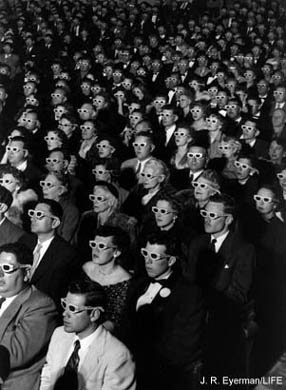 In the decades that have passed since the tumultuous sixties, things seem to have quieted down. Images of interracial couples, that once sent people screaming from the room, are now commonplace. It's no longer necessarily a career breaker to announce that one is gay. The world we see in shots of audiences is very different from the world we saw in the iconic Life Magazine picture of an audience in 3-D glasses in a theater: in that picture, every single person was white. Every one. [see right margin] African Americans were either missing completely or in the balcony and safely out of sight. Today, a similar shot would show a marvelous rainbow of faces, a fairer representation of what America really is: white, black, brown, and yellow; single and coupled; able-bodied and disabled. And most of us who remember the Good Old Days cheer at the difference in how we present ourselves to the world.
Most of us. But for some, all those changes were just sources of discomfort that were swept under the rug. If we don't think about them, they'll go away. If our immediate world remains predictable, we're OK.
And then America had the temerity to elect an African American as president. Those who fought the onslaught of cultural change could no longer pretend that things were really still OK.
The upheaval of the 25 years between 1954 and 1979, like the Viet Nam War that fell within it, is still being felt. Aftershocks of those temblors continue to resonate in our culture. And like any violent movement of the earth, we are left off-balance. And being off-balance makes us insecure, makes us want to find a place, whether physical or in memory, where we were safe.
So we want to go back to the way it was.
I can't figure out a better explanation for the behavior of legislators both in Washington and in state capitals around the country, legislators who were swept into office by people who wanted a solid piece of ground to stand on. Ground that did not include the safety of abortions in clean clinics. Ground that did not include contraception and the accessibility of women's health screening to all women, even the most poor. Women in particular seem to have become the target of the insecurity of the earthquake generation, because after all if women would only remember their place, things would be so much more bearable. The days of returning home to a wife in pearls and a waiting martini (or Coke) seem so appealing (never mind the cost to the women who did what their husbands wanted to the exclusion of their own needs).
I even wonder whether the illegal immigration problem would be so severe if the flood was coming from the north. Because the uptick in suspicion of people of color, the continuing racial profiling despite laws passed against it, are telling me that it's not just women who are being targeted. We are aware (or we should be) of the disproportion of black inmates in our prisons, not because more blacks commit crime, but because most blacks have to rely on overburdened public prosecutors who advise them to accept a plea bargain rather than go to court. The number of incarcerated blacks who are being released after decades of imprisonment thanks to improved forensic science only proves the point. All blacks, after all, look alike, so if one is accused and has not adequate representation, one ends up behind bars. And no one cares.
If Barack Obama's father had been a Swedish student here on a study visa, fathered a child, then went back to Stockholm, would Donald Trump and Orly Taitz still be stamping their feet and demanding a "real" birth certificate? But a man of Mr. Obama's skin color must be proved to be ineligible to hold his office. (We all know that his skin color alone should disqualify him from sitting in the Oval Office, but apparently the Founding Fathers lacked the foresight to insert that stipulation.)
Every time a member of the earthquake generation watches the 6 o'clock news, he or she is reminded that things aren't the way they should be. And he or she, out of a profound sense of insecurity, demands that everything that has changed in the past 50 years return to the way it was.
Look around. Nothing is the way it was after an earthquake. Just ask the people in Haiti. Or Japan. Or northern Italy. Or Northridge, California. The earth moves, landscapes we loved disappear, and new ones replace them, and in a decade or two we have come to be settled in our new landscape. Unless we are so mired in the past that we can only mourn what was and curse the fates that caused what we had to crumble.
It's time to wake up. The America that has emerged from the upheaval of the 50s and 60s and 70s is a richer, healthier, more vibrant America. It welcomes the contribution of effort of all its citizens. And to demand that we return to Father Knows Best is to do precisely what democracy is NOT about: comforting the minority to the exclusion of the majority.
I am indebted to Robert D. Putnam for the image of repeated upheavals in our society, described in his new book, American Grace.
Thursday, May 3, 2012
Washing Away the Week
We are told that there are so many ways to reduce or eliminate stress. Exercise. Meditate. Yoga. All of them are effective, but I found a new one last week that takes all of a minute (yes, a minute, if you are among the ADD population). It combines an insight found in an online publication with the wisdom of Rabbi Abraham Joshua Heschel. I considered doing it, figured out how to make it real, and oh my - it really worked.
The article, which appeared in the online edition of Spirituality and Health, reflected on the healing aspects of water. While immersion into a ritual bath has long been part of Jewish religious practice, not every Jew takes advantage of the practice, and frankly, it takes the time to find a local mikveh, get there, wait your turn...you get the idea. And I'm unaware (although I'm counting on my followers to correct me if I'm wrong) of any water practice among other faith traditions. The author of the article suggested that we take the opportunity to use the healing powers of water at times that would seem to be fairly mundane: when we take our morning shower, she suggests, allow the water to roll off us and speak or think words of purification for the day to come. Or if we shower at night, let it be a time to wash away the stress and spiritual impurities of the day. Remarkable, I thought. Really wonderful.
Then, a couple of days later, I took my turn in a rotation of rabbis who have been teaching Rabbi Heschel's book The Sabbath at my local synagogue. One of the points Rabbi Heschel makes in the chapter we were studying is the need to prepare spiritually for Shabbat. Even in traditional households, where women are focused on the home and children, the end of Friday preparations can be hectic - make sure the food is cooked, the children are bathed and dressed, the table is set, the candles are ready to be lit...But so much the more so in our contemporary society when both parents are often hurrying home from work, and certainly in the winter months when the sun sets early, we race home, checking all our prep items, and rush to our candles to light them (and the men often rushing to make the early Friday night service).
Spiritual life takes preparation. It takes as much work as preparing for an interview or an exam. Rushing toward the spiritual takes energy away from the ability to experience the connection we seek. We are too tired to appreciate what we have.
As the group discussed the need to stop and prepare, I shared with them to idea of using water. Perhaps, I suggested, we could make the point of washing our hands just before candle lighting or reciting kiddush (sanctification of Shabbat made over a cup of wine) or heading off to synagogue. And then I resolved to see if I could craft such a ritual in real life.
The next week was a killer. One stressful day after another. Difficult issues to confront. Decisions to be made. Disappointments to deal with. On Friday, I made sure my kitchen was prepared, and I set up my candles. Then I remembered the ritual I wanted to invent. I found the special cup I use to wash my hands before hamotzi (the benediction over bread), went to the sink and did the following:
1. Filled the cup.
2. Poured water over my hands but didn't recite a benediction since I wasn't ready to eat yet.
3. Shook out my hands.
It was here that the magic happened. I shook my hands only three or four times, but each time was a single strong, decisive shake. And with each shake, I let go of something.
"letting go of the stress"
"letting go of the worry"
"letting go of the anger"
and then I held up my hands as a doctor would when a nurse is going to glove her before surgery and I said
"getting ready to receive the holy" And the holding up of my hands and the words I spoke made me aware of the presence of God as I normally am not aware except for the moments after lighting my candles or putting on my tallit.
Then I went to dry my hands. And the most remarkable thing happened. I realized I'd shaken loose all the stress I'd brought with me to Friday night. I was the calmest I'd been in days. When my cousin came home I wished her a Shabbat shalom and smiled and she asked what was going on that made me so happy, and I told her about the ritual.
The calm I felt on Friday night has carried me through the week. I've ceased worrying about things I can't do anything about. I've slept better. The effect of a few shakes of my hands has been profound.
Tomorrow night I'll do it again. And prepare myself once again for a Shabbat of peace.
The article, which appeared in the online edition of Spirituality and Health, reflected on the healing aspects of water. While immersion into a ritual bath has long been part of Jewish religious practice, not every Jew takes advantage of the practice, and frankly, it takes the time to find a local mikveh, get there, wait your turn...you get the idea. And I'm unaware (although I'm counting on my followers to correct me if I'm wrong) of any water practice among other faith traditions. The author of the article suggested that we take the opportunity to use the healing powers of water at times that would seem to be fairly mundane: when we take our morning shower, she suggests, allow the water to roll off us and speak or think words of purification for the day to come. Or if we shower at night, let it be a time to wash away the stress and spiritual impurities of the day. Remarkable, I thought. Really wonderful.
Then, a couple of days later, I took my turn in a rotation of rabbis who have been teaching Rabbi Heschel's book The Sabbath at my local synagogue. One of the points Rabbi Heschel makes in the chapter we were studying is the need to prepare spiritually for Shabbat. Even in traditional households, where women are focused on the home and children, the end of Friday preparations can be hectic - make sure the food is cooked, the children are bathed and dressed, the table is set, the candles are ready to be lit...But so much the more so in our contemporary society when both parents are often hurrying home from work, and certainly in the winter months when the sun sets early, we race home, checking all our prep items, and rush to our candles to light them (and the men often rushing to make the early Friday night service).
Spiritual life takes preparation. It takes as much work as preparing for an interview or an exam. Rushing toward the spiritual takes energy away from the ability to experience the connection we seek. We are too tired to appreciate what we have.
As the group discussed the need to stop and prepare, I shared with them to idea of using water. Perhaps, I suggested, we could make the point of washing our hands just before candle lighting or reciting kiddush (sanctification of Shabbat made over a cup of wine) or heading off to synagogue. And then I resolved to see if I could craft such a ritual in real life.
The next week was a killer. One stressful day after another. Difficult issues to confront. Decisions to be made. Disappointments to deal with. On Friday, I made sure my kitchen was prepared, and I set up my candles. Then I remembered the ritual I wanted to invent. I found the special cup I use to wash my hands before hamotzi (the benediction over bread), went to the sink and did the following:
1. Filled the cup.
2. Poured water over my hands but didn't recite a benediction since I wasn't ready to eat yet.
3. Shook out my hands.
It was here that the magic happened. I shook my hands only three or four times, but each time was a single strong, decisive shake. And with each shake, I let go of something.
and then I held up my hands as a doctor would when a nurse is going to glove her before surgery and I said
"getting ready to receive the holy" And the holding up of my hands and the words I spoke made me aware of the presence of God as I normally am not aware except for the moments after lighting my candles or putting on my tallit.
Then I went to dry my hands. And the most remarkable thing happened. I realized I'd shaken loose all the stress I'd brought with me to Friday night. I was the calmest I'd been in days. When my cousin came home I wished her a Shabbat shalom and smiled and she asked what was going on that made me so happy, and I told her about the ritual.
The calm I felt on Friday night has carried me through the week. I've ceased worrying about things I can't do anything about. I've slept better. The effect of a few shakes of my hands has been profound.
Tomorrow night I'll do it again. And prepare myself once again for a Shabbat of peace.
Monday, June 6, 2011
The Other F Word
George Santayana observed famously that those who do not remember history are doomed to repeat it. It is that observation that makes reading history and remaining up to date on current events so important. Sometimes, keeping up to date on current events can be depressing at least, frightened at worst, but the alternative is to invite catastrophe. Item: More anti-abortion legislation has been passed in the months since the 2010 election than in the decades since Roe v. Wade. Legislatures, both state and federal, faced with mounting deficits and unemployment numbers, have chosen instead to put their combined energies into restricting the right, established by the U.S. Supreme Court, of a woman to chose what happens to her body.
Sub-item: the laws, typically (with some hair-curling exceptions) do not decree abortion to be illegal (can a state make illegal something the federal courts have determined to be legal? That remains for some brave woman to bring suit if these laws are passed – and the prospects for passage are unfortunately very good), only make it damned hard for a woman to find an abortion provider. South Dakota, as an example, has one abortion provider for the entire state, and if you look at your map, it’s not a small state. If you find yourself in the position of needing an abortion, you have to come up with both transportation and lodging fees to get to the provider. Right now, there’s a 24 hour waiting period between checking in with the provider and actually having the procedure. But wait: there’s more. If the legislature has its way, the waiting period will be increased to 72 hours – increasing the number of nights a woman must pay for lodging. And yet more: the provider has only limited office hours, so 72 hours usually translates to a full week between the first visit and the procedure. With many women unable to take a full week to travel across the state and/or be able to come up with the additional fees for travel and lodging, these draconian rules put safe, legal abortion out of the reach of many women. Oh, and did I forget to mention the “counseling” the women have to endure? As if having an abortion is a decision come to on a whim. The arrogance of these legislatures, imposing themselves between a woman and her doctor (and her clergy if she chooses to include him/her) is breath-taking. And yet some states are working to criminalize abortion to the point of incarcerating providers (and some have even considered jailing women who have sought abortions). The clock seems to be turning back to 1900. While people are using up their unemployment benefits and losing their homes, legislatures are targeting women with unwanted pregnancies.
Item: A number of state legislatures have stripped unions of their bargaining power. Some of my Republican friends have observed that while unions once had a place, now they’ve outlived their usefulness. Really? Is salary and health care the only reason to bring management to the bargaining table? What about safety issues? What about length of hours and breaks and lunch? What about the quality of the work environment? If you think that unions are no longer necessary, get rid of them and see how fast municipalities are ready to spring for new safety equipment for fire fighters and police officers without the threat of a work stoppage. No one with budget responsibilities ever spent a cent unless pushed to do so, and if striking gets the money spent to ensure the safety of the work force, then that’s what it takes. And how to mobilize without a union? (Although the rebels across North Africa and the Middle East seem to have succeeded with Twitter and Facebook, but come on. This is America. Do we really need to resort to technology to bring management to the bargaining table for simple requests? Wait – I guess we do now, in too many states across the Midwest.)
Item: Michigan has gone one step further and empowered the state to dissolve the local, legally elected government of any municipality it chooses and to put a state-appointed – what, czar? uberfuerher? director? – over the affairs of the municipality. What kind of country has states dissolving local government? Apparently, ours.
Item: San Francisco, long a favorite city of mine, now has on an upcoming ballot an initiative to criminalize circumcision. And the most troubling part of the text is that there is no exemption for religious observance. We Jews of course circumcise our boys on the eighth day of life, and Muslims circumcise their boys before puberty. These are religious obligations. Even in the darkest days of Prohibition, accommodations were made for wine used for ritual purposes. This initiative goes way beyond the boundaries of liberal how-can-you-mutilate-your-babies mentality. The most frightening part? Check out this link. If you think, as I did a week ago, that this is just foolishness from people who want to leave circumcision to their boys when they turn 18, read about Foreskin Man (I kid you not) and look carefully at the graphics. The art work in this “publication” mirrors some of the worst of Nazi propaganda in the dark days before the implementation of the Final Solution. www.foreskinman.com
So how do we connect the dots?Look around. What’s going on in our country? We are still in the throes of the worst financial crisis in 80 years. Unemployment as of yesterday went over 9% nationwide, far higher in many states (including here in California). People are frightened, and when people are frightened, they look for scapegoats and easy answers.
What’s “the other F word”? Fascism.
Fascism, as in the hatred of the Other, the mistrust of the Other, and the circling of the wagons while attempting to build a society that’s ordered and predictable. Women know their place. Everyone looks like us (read: white and Christian). Law-breakers are dealt with mercilessly. People who follow laws informed by non-Christian faith traditions are suspect and must be controlled. Unions are the expression of the people and therefore must be silenced. Only a strong central government can be trusted to take care of its people (even, as in the case of personalities like Michelle Bachman and Sarah Palin, they don’t even have their history straight). Rights get to be restricted. And if you say something wrong long enough, people will begin to believe it. Like “death panels.” And “our black president was born in Kenya.”
Change is frightening. Having a national leader that doesn’t look like “us” is frightening. Instability is very frightening. And the way to deal with change and instability is to impose more and more tightening laws that invade people’s personal lives, imposing the ethics of one faith tradition onto those who do not share that faith tradition.
We hear so much about the right to bear arms. What about the part that says that the government shall make no law regarding the establishment of a religion? Or do we just pick and choose which part of the Constitution we hold sacred and which part is disposable?
Do we rewrite history to make it fit our contemporary notions of safety and order? Or do we study history as it is, in order truly to preserve the safety and order of the society we have built over more than two centuries?
We need to connect the dots. We need to stay awake. We need to speak out, to support the good people of Wisconsin who continue to sit in at the state capital, to support Planned Parenthood, 97% of whose budget goes to providing contraception advice and free mammograms and Pap smears to women who can’t afford to get them elsewhere. We need to keep in mind that no – NO – federal funding goes to providing abortions through Planned Parenthood, so those who wish to cut their funding (and some states have already succeeded) are not reducing the number of abortions in their state; rather, they are limiting women’s access to preventive health care.
Attacks on unions. Attacks on women’s health. Attacks on religious freedom.
Are we going to remember history? Or, God forbid, will we allow it to be repeated?
Monday, May 16, 2011
Jewish Parenting Through the Lens of the Liturgy - 3
Traditionally, morning prayers open with a list of 14 benedictions, originally said as people began their day - there was a prayer for unwrapping oneself from one's covers, for putting on one's shoes, for tying the belt around one's coat. Eventually, the list found its way into the prayerbook and was recited together, whether at home or in the synagogue, after all those preparations had already been completed. As I have read these benedictions, I have been regularly impressed with lessons they can teach us as parents, and in this blog I will be reflecting on each of the benedictions, one a day, for the next few weeks (holidays permitting).
*******
The Third Benediction – Religious Identity
ברוך אתה ה' אלהינו מלך העולם שעשני ישראל
Praised are You, Adonai, our God and Sovereign of the Universe, who made me a Jew.
There is much to be written about this brakha. I have met with so many people who were in the process of conversion, either about to begin their study or about to be immersed in the mikveh, and over and over again I hear the same thing: I’ve always been a Jew. This is just making it official.
This conviction suggests a truth to be found in our brakha: that religious identity is part of our make-up as much as height, eye color, and sexual orientation. Of course, we might then question those who profess no religious belief, or those who are conflicted about the existence of God and how they might worship that God. Are they denying their essential spiritual identity?
I can’t address those important questions. What I do know is that the Jewish tradition speaks of the pintele yid, the Jewish spark that is found in the Jewish soul. No matter how assimilated the family, how unidentified the family, somehow that tiny spark finds a gentle breeze to blow on it and fan it into a flame. How it is that some have that spark and others do not is a quandary of a mystic nature, and I am far too unqualified to address it here.
But what does all this have to do with parenting?
When our children are born, we watch with delight as they blossom, from tiny infant to toddler who learns “No” very early and enjoys pushing the envelope, to adolescent who raises pushing the envelope to an art form. Along the way we watch talents and interests emerge. Who will this precious gift of God be? What will he or she be? How will our child contribute to the community? What sort of partner will we hope he or she finds – what characteristics do we want to see encouraged, which ones balanced with someone complementary?
We worry about the friends they choose, the schools they attend, the extracurricular activities they participate in. Have they accumulated enough activities to impress the admissions committees of the colleges they’ve chosen?
We set curfews for them, give them rules, let them know what’s expected of them as members of our family.
And yet for so many parents, encouraging religious education is merely a means to an end: the bar or bat mitzvah celebration. And even among those parents who opt for a celebration of their child’s coming of age within Jewish tradition, the spectrum varies from day school to supplementary school to a tutor and a private service, with the party being the most important element of the day.
We want our children to be functioning members of society, but too many of us feed our children’s intellect while starving their souls.
I must tell you that when people learn I’m a rabbi, whether they’re Jewish or not, they feel comfortable sharing incidents or whole themes from their childhood dealing with their religious upbringing – or lack of it. I remember one young man who shared a dinner with me and members of my first congregation many years ago. He reflected that both his parents had been raised as Protestants, but different denominations. Each of them had had parents of differing denominations as well, so that by the time he arrived on the scene, there were maybe six different ways of worshipping Jesus in his family. His parents’ strategy was not to offer him any of them. It was clearly too complicated for them, too much of a mine field to traverse, so they gave him a terrific secular education but never addressed his soul. He said to me, “I want to think about God, but I don’t know how think about thinking about God.” I suspect (although I can’t be sure) that if he’d told his parents that, they would have been puzzled at the least.
I also remember an interfaith couple that, like many, decided to give their daughter both Catholicism and Judaism. She was converted by my predecessor and then the next day she was baptized. Her education consisted of Hebrew school on Sunday and catechism on Saturday. I finally told her father that she needs to be given an address for her soul. I would rather, I told him, see her go to church regularly with her mother and know she’s being given a consistent religious education than be taught two very different paths and be expected (a) to sort them out by herself and then (b) choose, essentially between Mom and Dad.
I was asked once as part of an interview for the post of senior rabbi at a Midwestern congregation, “Rabbi, how do you teach God to children?” I told them frankly that we don’t teach God to children. Children are born far closer to God than we will ever be. Their souls are new and freshly given by the Holy One. We should be asking them what they know about God.
What happens from birth to adulthood is the channeling of that belief by how the adults in their lives talk about God (or not). Furthermore, belief in God is only part of the conversation; the rest of it has to do with how we worship the God in whom we believe, how that belief translates into behavior and the search for community. Simple faith is a lonely thing unless you have others with whom to worship, and with whom to sort out what God’s will means to you. For us Jews, that means family and community with whom to study Torah and build communal institutions so that we can follow the path our tradition has defined for us. Having a child, then, means not only committing to a lifelong (yes, it really is lifelong) endeavor of educating and training and civilizing (I’m thinking of those toddlers and adolescents again) and constantly reassuring with unconditional love. It means before they’re born sorting out what God means to you, what your faith community means to you, and finding a place in that community where you are comfortable and can feel joy. Then, when your children are born, they can watch you participate in your community’s events and celebrations because they’re meaningful to you. Children know very early what’s important to their family, and they perceive very quickly that religious life is irrelevant if it’s only “for the children.” I was thinking the other day of my first Hanukkah as a married woman. We’d moved out of state for my husband’s education, and I spoke to my parents, excited about having lit our new hanukkiyah for the first time. “Oh, we didn't light ours,” my mother said, to my astonishment. “You’re not here so it’s not so important.” Of course, in hindsight, I realize that that first year their only child was out of the house was a big adjustment for them, but at the time I couldn’t believe that all those years, my parents had celebrated Hanukkah only for me.
I’m slow, I guess. Other kids pick up on things much more quickly. One of my fifth grade students once observed that sitting in a sukkah for a week was a negative mitzvah because “nobody does it.” In his home, at least, there was no sukkah. The synagogue’s sukkah wasn’t “real” because after all it was the synagogue’s sukkah. I tried to explain that thousands of Jewish families around the world (including mine) used their sukkot every year, but he wasn’t convinced.
How can we say our brakha every morning with joy, affirming our awe at being part of this remarkable people? We can study Judaism just as we studied whatever texts we needed to study to pursue our profession, recognizing the truth of the brakha “thank You for the obligation of making Torah study our occupation.” We can live Jewishly by bringing Jewish practice into our homes and our lives. We can study with others to learn what makes Judaism remarkable to them. And in this way we become role models for our children.
When we do recite that brakha, let’s use it to remind us to do all we can to encourage our children to come to value being Jewish as much as we have learned to be.
Subscribe to:
Posts (Atom)